
ADHD Tax: The Hidden Cost of Executive Dysfunction (and How to Reduce It)
Late fees, missed deadlines, duplicate purchases — the ADHD tax is real and cumulative. Here's what causes it and how to reduce it with smarter systems.

Quick Answer: The “ADHD tax” refers to the extra time, money, and energy that executive dysfunction costs people with ADHD — late fees, missed opportunities, costly mistakes, and the cognitive overhead of managing a brain that fights against routine systems. You can’t eliminate it entirely, but the right tools and strategies significantly reduce it.
If you have ADHD, you’ve paid the ADHD tax. You just might not have had a name for it.
The late fee on the bill you forgot to pay — despite fully intending to pay it. The missed flight because time blindness made 90 minutes feel like enough buffer. The groceries you bought because you forgot you already had them. The subscription you meant to cancel three months ago. The penalty for the tax return filed late.
Individually, each instance feels like carelessness. Across a lifetime, it adds up to a significant financial and emotional toll that has nothing to do with intelligence or effort.
What is the ADHD tax?
The ADHD tax is the accumulation of practical costs — financial, temporal, emotional, and relational — that arise from the executive function challenges of ADHD. It’s not laziness or poor character; it’s the predictable output of a brain that struggles with working memory, time perception, initiation, and follow-through.
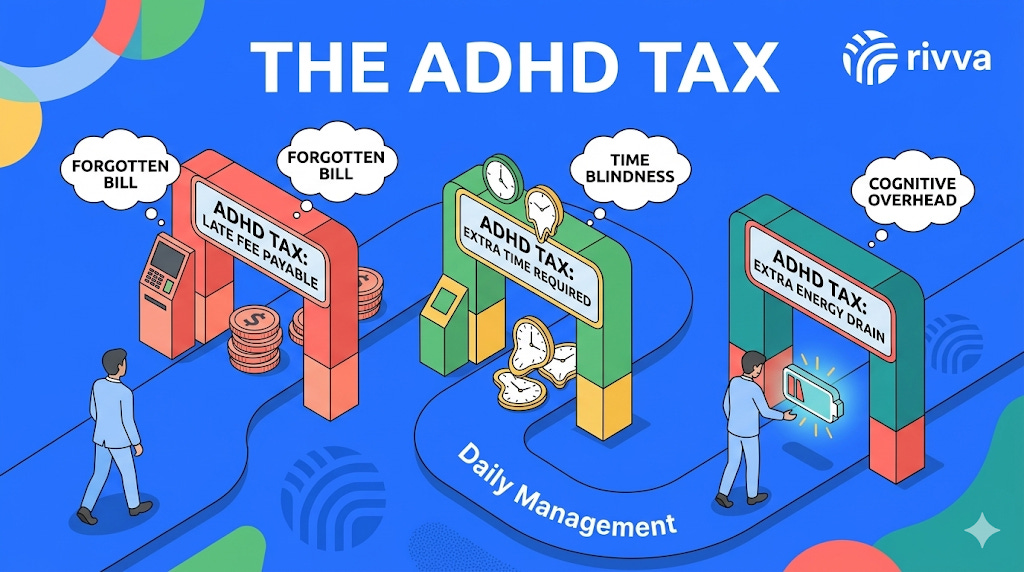
Financial ADHD tax examples:
Late payment fees and interest on bills
Missed tax return deadlines
Subscription services not cancelled in time
Overdraft fees from forgotten transactions
Duplicate purchases from forgotten stock
Premium paid for last-minute booking (flights, hotels, gifts)
Lost income from missed invoices or billing delays
Time ADHD tax examples:
Time lost to disorganisation and searching for things
Rework required due to errors from rushed or distracted work
Time spent on shame spirals and recovery from missed obligations
Longer task completion time due to initiation delays
Emotional ADHD tax examples:
Shame from repeated failures at basic tasks
Relationship strain from forgetting commitments
Anxiety from unpredictable consequences of forgetfulness
The mental overhead of constant catching-up
Why it happens
The ADHD tax isn’t random. It clusters around specific executive function challenges:
Working memory impairment: Things not written down effectively don’t exist. “I’ll remember to pay that” doesn’t work reliably when working memory can’t hold the information until action time.
Time blindness: The inability to accurately sense time passing means deadlines feel further away than they are, and “I have enough time” is systematically wrong.
Task initiation: Knowing you need to do something and actually starting it are disconnected. Important tasks sit undone not from neglect but from genuine initiation failure.
Emotional regulation: Difficult or anxiety-provoking tasks (finances, admin, anything with consequences) trigger avoidance that compounds the problem over time.
How to reduce the ADHD tax
Automate the non-negotiables
Direct debit every bill that can be direct-debited. Automate savings. Set subscriptions to annual rather than monthly (one renewal to track instead of twelve). Remove the memory requirement from anything where the cost of forgetting is financial.
Externalise everything
Don’t trust working memory. Every bill due date, every renewal, every commitment goes into a system — calendar, task manager, rivva. “I’ll remember” is not a system. The external system is the system.
Use energy-appropriate scheduling
Financial tasks, admin, and anything with real consequences should be scheduled in energy-appropriate windows — not thrown into whatever slot is available. Attempting a tax return during a cognitive dip is a setup for errors. rivva’s energy zone scheduling places high-stakes admin in Peak windows where your executive function is most available.
Build recurring reminders with buffer
Instead of a reminder on the due date, set reminders three days early. Time blindness means “due today” can be functionally the same as “due in an hour” — not enough buffer to act. Build the buffer into the system.
Reduce financial friction wherever possible
The more steps required to pay a bill, the less likely it gets done on a low-executive-function day. Saved payment methods, one-click processes, and auto-renew reduce the initiation load of financial admin.
Frequently asked questions
What is the ADHD tax?
The accumulated extra costs — financial, time, and emotional — that arise from ADHD executive function challenges. Late fees, missed deadlines, duplicate purchases, and the overhead of managing a brain that doesn’t operate on neurotypical assumptions.
Is the ADHD tax real?
Yes. Research on ADHD and financial outcomes consistently shows higher rates of debt, late payments, and financial instability among adults with ADHD, independent of income level. The costs are real and cumulative.
How do I reduce the ADHD tax?
Automate financial obligations, externalise everything into a reliable system, use energy-aware scheduling for high-stakes admin, and build buffer into reminders. The goal is removing the memory and initiation requirements from routine financial tasks.
Does rivva help with ADHD tax?
Yes. rivva’s recurring task scheduling, energy-aware planning, and Nia’s proactive nudges address the core mechanisms of ADHD tax — forgotten obligations, wrong-time task scheduling, and initiation failure on important admin.
Why do people with ADHD pay more late fees?
Time blindness (underestimating time to deadline), working memory failure (forgetting the bill exists), and task initiation difficulties (knowing it needs doing but not starting) combine to make late payments structurally predictable for ADHD. Automation removes the human memory requirement from the equation.