
What Is an Energy Operating System?
How rivva Adapts to Your Day

Quick Answer: An energy operating system is a planning framework that treats your daily capacity as the primary variable — not your time, not your task list. rivva is built on this model: Nia learns your energy patterns, maps your day into peak, dip, and recovery zones, and adapts your plan to match what you can actually do.
Most productivity systems are time operating systems. They manage your hours: slot tasks into available time, respect deadlines, and track how long things take. Time is the resource they’re built around.
But for anyone with ADHD, chronic illness, or significant day-to-day energy variability, time is not the scarce resource. Energy is.
An empty hour on a crash day is not the same as an empty hour at peak capacity. Scheduling a demanding task into the first available slot, ignoring whether that slot coincides with your cognitive low point, is why so many beautifully organised calendars produce so little actual output.
An energy operating system fixes this.
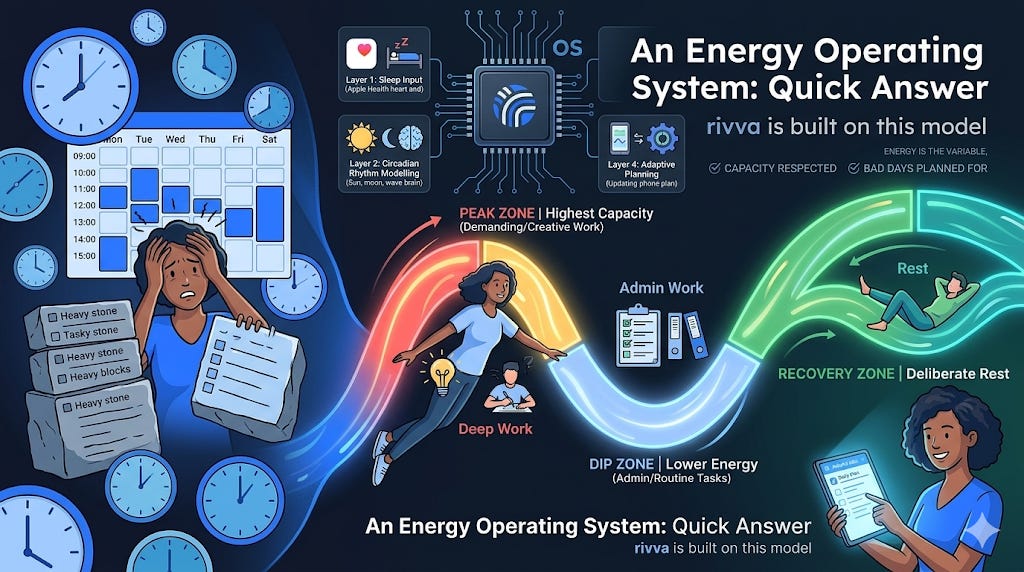
What an energy operating system does
An energy OS treats your available cognitive and physical capacity as the primary variable that planning should optimise around. It asks not “when is there time?” but “when is there capacity?”
The practical implications:
Tasks are placed in energy-appropriate windows, not just available slots
The day’s plan adjusts based on your actual state, not the ideal state you planned for
Recovery and downtime are built in, not treated as wasted space
Bad days are planned for, not just good days
How rivva implements this
rivva’s energy operating system works through four connected layers:
Layer 1 — Sleep input. Each morning, rivva reads your sleep quality and duration from Apple Health. Sleep is one of the strongest same-day predictors of executive function and cognitive performance — especially for ADHD brains, where poor sleep has outsized effects on attention and initiation.
Layer 2 — Circadian rhythm modelling. Over time, Nia builds a model of your personal energy rhythm: when your peaks typically occur, when dips are predictable, what your recovery pattern looks like. This is calibrated to you specifically, not to a generic “morning person vs. night owl” category.
Layer 3 — Energy zone mapping. Your day is divided into three zones:
Peak — highest cognitive capacity. Reserved for demanding, creative, or high-stakes work.
Dip — lower energy. Scheduled for admin, routine tasks, and low-effort items.
Recovery — deliberate rest. Not wasted time — protection against depletion.
Layer 4 — Adaptive planning. Nia places your tasks into the appropriate zones, builds your Morning Brief based on that day’s energy forecast, and uses Smart Reschedule to rebuild the plan in real time when things change. The plan is never static — it updates as your day does.
Why this matters for ADHD specifically
For ADHD brains, the energy operating system model closes a gap that time-based planning can’t:
Hyperfocus protection: Deep work is scheduled in peaks, protecting those windows from being consumed by low-value tasks
Crash day adaptation: On low-energy days, the plan automatically scales back rather than accumulating overdue items
Initiation support: Knowing exactly when to do something (a Peak window) removes one layer of decision-making that often triggers paralysis
Capacity respect: The plan doesn’t assume you have the same capacity every day, because you don’t
Frequently asked questions
What is an energy operating system?
A planning framework that treats energy and cognitive capacity as the primary resource, placing tasks in windows that match what your brain can actually do rather than just what time is available.
How does rivva’s energy system work?
rivva reads your sleep data from Apple Health, models your personal circadian rhythm, maps your day into Peak / Dip / Recovery zones, and places tasks in energy-appropriate windows. Nia adapts the plan daily based on your actual state.
Is an energy operating system better than time blocking?
For ADHD and energy-variable schedules, yes. Time blocking assumes consistent capacity across all blocked time. An energy OS accounts for when that capacity is actually available, placing demanding work in peaks and protecting recovery periods.
Can you use rivva without wearables?
Yes. rivva’s energy zone features work with manually reported energy levels if wearables aren’t available. Sleep integration enhances the accuracy of Nia’s planning, but it’s not required to use the energy zone system.
What is a Peak energy window?
Your peak window is the period of your day where your cognitive capacity is highest — typically tied to your circadian rhythm. rivva identifies this window for you and schedules your most demanding tasks there.