
Why Your Planning App Is Making Burnout Worse
Most planning apps are built for consistency. But consistency isn't the problem — capacity is. Here's what your planner should be doing instead.

There’s a strange irony at the center of modern productivity culture. We have more planning tools than at any point in history. And yet burnout rates have not gone down. For many knowledge workers, they’ve gone up.
The easy explanation is that people are using the tools wrong. They’re not disciplined enough. If they just committed harder, the tools would work.
Here’s the harder explanation: the tools themselves might be part of the problem. Not because they’re badly built. But because of what they’re designed to do — and whose interests that design ultimately serves.
What Planning Apps Are Optimized For (And It’s Not Wellbeing)
Most planning apps are built around a core metric: task completion. Their success case, implicitly or explicitly, is a cleared list. But the optimization creates a specific kind of pressure that doesn’t account for one critical variable: your actual capacity.
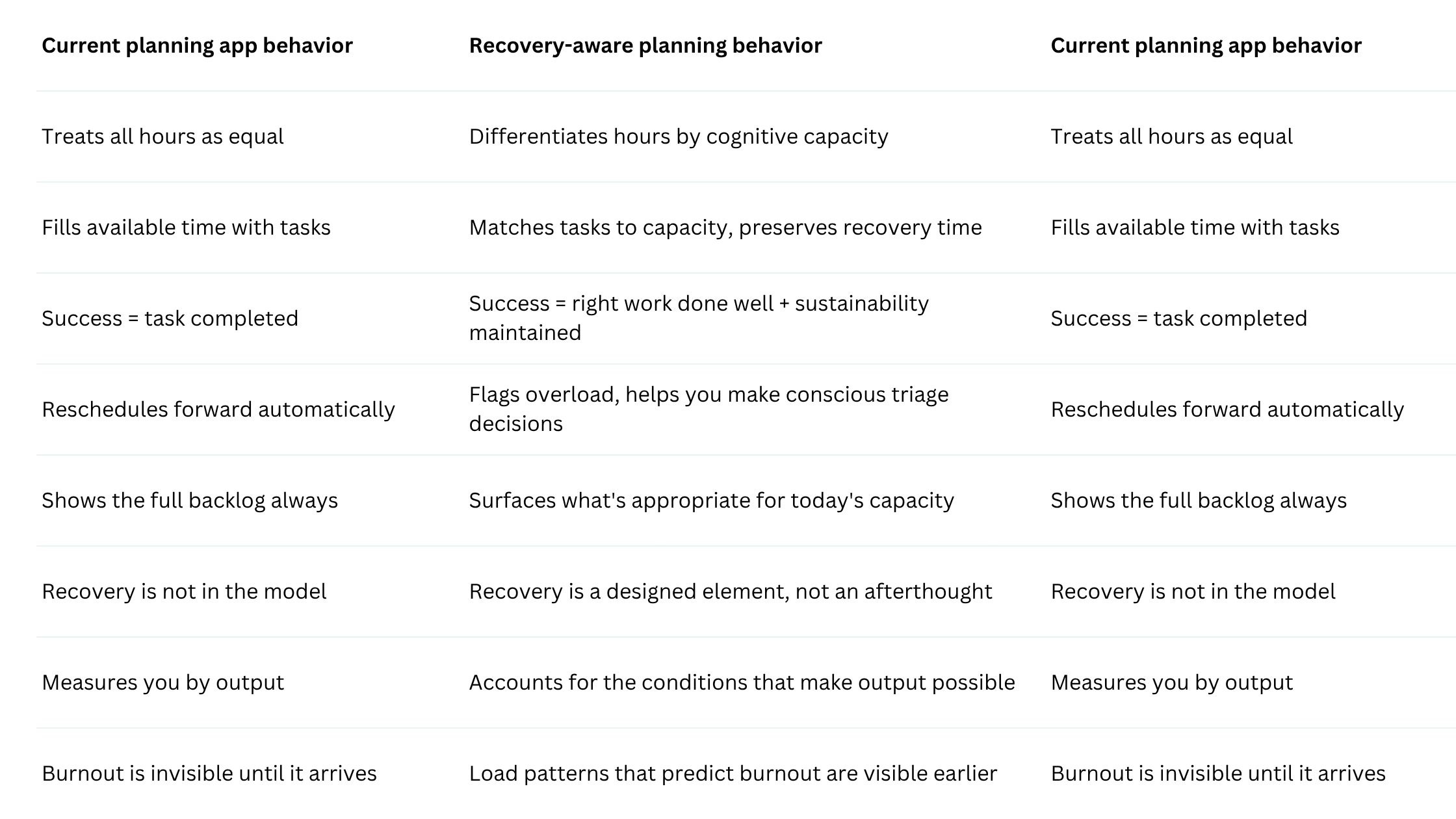
Every hour is treated as equal. A 9 a.m. slot on a well-rested Tuesday and a 3 p.m. slot the day after a difficult emotional conversation are both just “available.” The calendar doesn’t know the difference.
Success is binary. The task is either complete or it isn’t. This structure doesn’t capture whether the work was done well or poorly, or whether completing it at that time left you depleted for everything that came after.
The system is implicitly always on. There’s no concept of rest as a designed element. A well-scheduled day in most planning apps is a full day — a day where every hour has a purpose and nothing is wasted.
The cumulative effect is a tool that treats you as a resource to be allocated rather than a person with finite, variable cognitive capacity.
The Specific Ways Planning Apps Contribute to Burnout
The always-visible backlog. Most task management apps show you everything at once — every incomplete task, every project, every someday item. Research on “open loops” in cognitive psychology is consistent: visible undone work creates background anxiety even when you’re not actively thinking about it. An app that surfaces all of your incomplete work simultaneously is an app designed to be slightly stressful all the time.
No concept of capacity — only availability. Planning apps know when you have free time. They have no model of how much cognitive bandwidth you have in that free time. Scheduling logic treats an open hour at the end of an already demanding day the same as an open hour at the start of a fresh one.
Rescheduling forward creates a debt spiral. When you don’t complete something by its due date, the standard response is to push the due date forward. The task reschedules. It accumulates. You fall behind, so you try to catch up by adding more to tomorrow’s plan. You can’t catch up, so you fall further behind. The app continues offering you an accurate picture of your deficit with no mechanism for addressing the underlying cause: your capacity was never adequate to the load.
“Productivity guilt” when the plan isn’t followed. When you build a plan and don’t follow it, the record of that failure lives in the app. Over time, this creates a specific kind of shame that is particularly insidious because it has a record. It’s not just a feeling; it’s documented.
What a Recovery-Aware Planner Would Look Like
It would know the difference between “available” and “capable.” An empty hour and a high-capacity hour are not the same thing. A recovery-aware planner would have a model of your cognitive state and would use that model to distinguish time you have from time you can use well for demanding work.
It would build recovery into the schedule by default. Not as a luxury, but as a structural element. Demanding work would be followed by deliberate lower-demand time. The system would treat cognitive recovery the way good physical training treats rest: not as wasted time, but as the mechanism that makes the demanding work possible.
It would adapt to bad days without creating a shame record. On a day when your capacity is reduced, a recovery-aware planner wouldn’t surface your entire task backlog as evidence of your inadequacy. It would help you find what’s actually achievable today.
It wouldn’t mistake busyness for progress. A full day isn’t a good day by definition. A day where you did your three most important things well, with appropriate recovery between them, might look emptier than a day of frantic context-switching — but it’s worth more.
Current Planning App Behavior vs. Recovery-Aware Behavior
How rivva Approaches This Differently
rivva is an AI daily planner that connects to wearables — Apple Watch, Fitbit, Oura, Whoop — and uses your actual sleep and recovery data to build what it calls an Energy Timeline: a visual map of your cognitive peaks and dips across the day. Its AI assistant, Nia, schedules tasks into those peak windows automatically and adjusts when circumstances change.
rivva’s scheduling logic isn’t just about availability — it accounts for your current recovery level when placing work. Hard tasks go into peak windows. Lighter work goes into dip windows. When your sleep data shows a rough night, the system’s model of your day updates accordingly, rather than maintaining a plan built on an assumption of full capacity.
Recovery periods between demanding tasks aren’t something you have to remember to build in — they’re part of how the schedule is constructed by default.
What You Can Do Right Now
Schedule with capacity in mind, not just time. Before you add something to your calendar, ask: do I have the cognitive bandwidth for this when I’ve scheduled it? Not just “is the slot free?” but “is this the right kind of task for the state I’m likely to be in at that time?”
Build recovery between demanding tasks as a non-negotiable. If you have a difficult meeting followed immediately by a complex writing task, something is going to suffer. A 20-minute walk or a deliberately easy task between demanding ones is what makes the next demanding task possible.
Define a minimum viable day for low-energy days. Right now, before you need it: what are the two or three things that, if they happen on a difficult day, make the day a real success? Keep this somewhere accessible. On a hard day, execute your minimum viable day and call that a win.
Stop measuring success by task completion rate alone. A day where you completed 24 tasks is not automatically better than a day where you completed five and the five were the right ones, done well, without destroying your capacity for the rest of the week.
Frequently Asked Questions
Is it the apps’ fault that I’m burnt out, or is it something else?
Probably both. Burnout is usually multi-causal — structural overwork, unclear expectations, lack of recovery, and yes, planning frameworks optimized for output rather than sustainability. Apps aren’t the root cause, but they’re not neutral either.
Doesn’t talking about capacity just make it easier to rationalize not doing hard things?
The concern is valid. The way to stay honest is to track over time rather than reporting in the moment. If you consistently claim low capacity, the pattern becomes visible and worth examining. But the abuse case shouldn’t prevent the legitimate use case. Most people with burnout are not rationalizing rest. They’re not resting enough.
What if my job just requires me to be available and working all day?
Then you’re in a genuinely difficult situation that no scheduling tool fully resolves. What you can do is be strategic about which of those required hours contain your best work. If you can protect even one or two high-demand windows a week for your most important work, that’s better than nothing.
I’ve tried lots of systems and nothing sticks. Is something wrong with me?
Almost certainly not. Most productivity systems are designed for people with stable, predictable capacity and strong executive function. If you have variable energy or ADHD, systems designed without those factors in mind will keep failing you. The answer isn’t harder commitment to the wrong system. It’s finding an approach that accounts for how your brain actually works.
Bottom Line
If you’re burnt out and your planning app makes you feel behind before the day starts, there’s a reason for that. These tools were built to track output. They weren’t built to track the conditions that make output sustainable. They don’t know the difference between you being available and you being capable. They record your failures and don’t ask why they happened.
The place to start is simple: stop treating a full day as a good day. Start asking whether the work you scheduled can actually happen given the state you’re in. Build in recovery, not as something you earn, but as something your schedule assumes you need.
The right question isn’t “how much can I do today?” It’s “what can I do well today, and what do I need in place to do it well again tomorrow?”