
What Is Energy-Aware Scheduling? (And Why It Works)
Most calendars block time. Energy-aware scheduling matches your hardest tasks to your sharpest hours — and quietly rearranges the rest around how you actually feel.

Most productivity systems are built on a quietly false assumption: that all hours are roughly equivalent. That 9am Tuesday is the same as 3pm Thursday. That a free slot in your calendar is the same as available cognitive capacity.
Energy-aware scheduling is the attempt to fix this approximation. Instead of asking only when time is available, it asks when cognitive capacity is available, and whether that capacity matches what the task actually requires. It’s a shift from calendar management to capacity management.
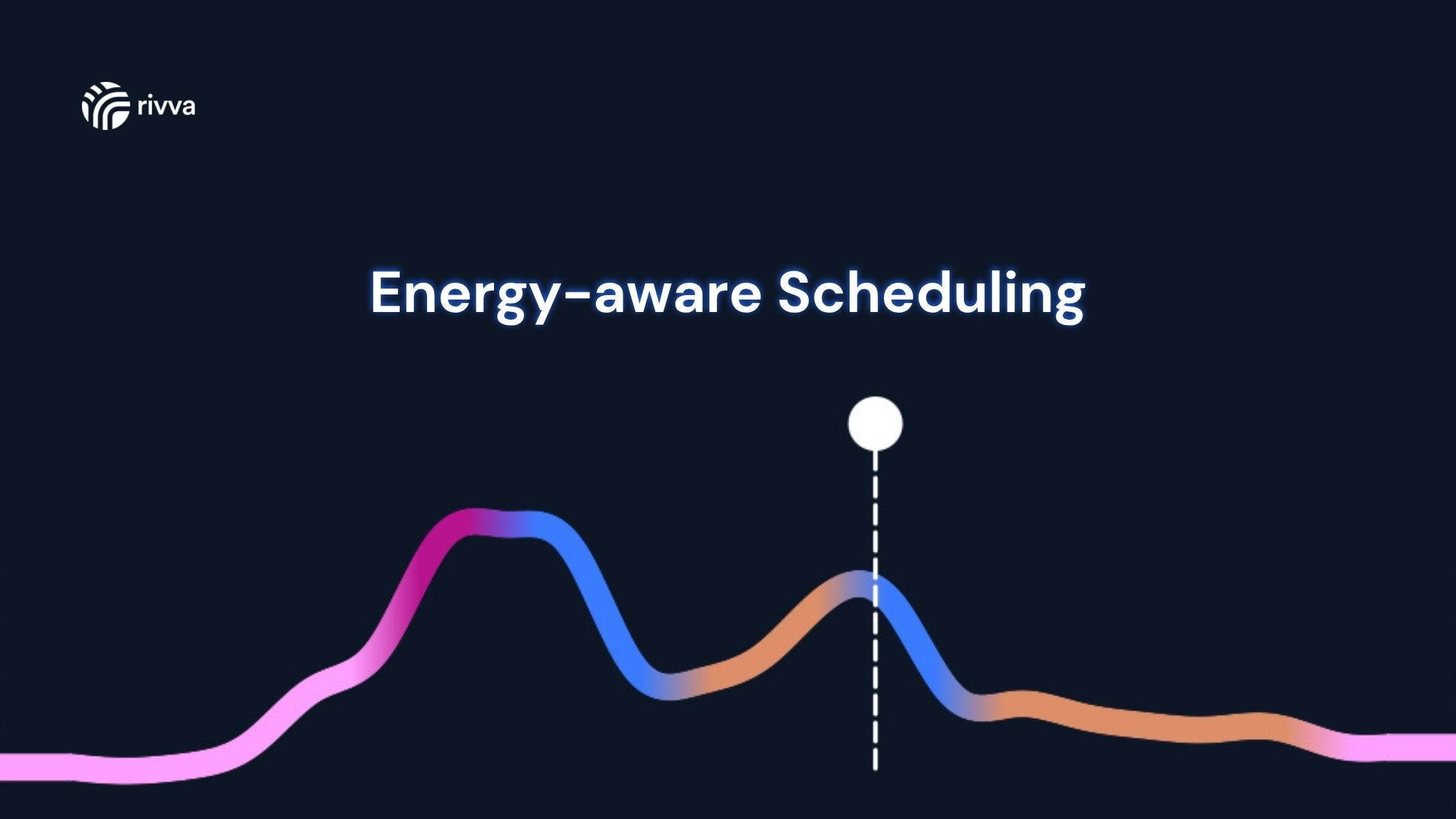
What Is Energy-Aware Scheduling?
Energy-aware scheduling is a planning approach that matches the cognitive demands of tasks to the times when you’re most suited to meet those demands — and rearranges lower-demand work to fill the windows when your capacity is reduced.
Your brain has periods of peak alertness, clear thinking, and high executive function — these are your cognitive peaks. It has periods of reduced alertness, slower processing, and limited working memory — these are your dips. The time between tasks also matters: your recovery state, how much regulation your nervous system has had to do, and how well you slept all affect where your capacity baseline sits at any given hour.
A practical version: deep analytical work during your morning cognitive peak, collaborative work mid-morning when interaction is energizing, light email and administrative work in the post-lunch dip, and more structured creative work in the late-afternoon recovery window.
This is different from simply protecting “focus time.” Focus time protection says: I need uninterrupted blocks. Energy-aware scheduling says: I need the right kind of work in the right kind of block, and the right kind is determined by when my brain is actually ready for it.
The Science Behind It
Circadian Rhythms and Cognitive Performance
Your body runs on a roughly 24-hour biological clock that governs core body temperature, hormone levels, and directly affects cognitive performance. Research on circadian variation consistently finds that alertness, working memory, and executive function peak in the late morning for most people (roughly 9am–12pm for conventional wake times), drop in the early afternoon, and recover partially in the late afternoon before declining again toward evening.
The Post-Lunch Dip
The afternoon alertness dip is driven in part by circadian timing — there’s a biological pressure toward reduced alertness in the early afternoon that exists independently of what you eat. The post-lunch window — roughly 1pm–3pm for most people — is physiologically suited for lower-demand tasks: review, administrative work, routine processes.
Ultradian Rhythms: The 90-Minute Cycle
Alertness oscillates in cycles of roughly 90 minutes. Sustained focus has a natural ceiling of roughly 90 minutes before the brain needs some form of recovery. Working in cycles aligned with this rhythm — focused work followed by genuine rest — is more sustainable than trying to extend focus indefinitely.
Sleep Debt and Prefrontal Cortex Function
The prefrontal cortex — responsible for planning, impulse control, working memory, and prioritization — is disproportionately sensitive to sleep deprivation. After one night of poor sleep, prefrontal function is measurably reduced.
Heart rate variability (HRV) is one of the best measurable proxies for recovery state. High HRV generally indicates good recovery and autonomic readiness; low HRV indicates accumulated stress or inadequate recovery. Wearables that measure HRV overnight can give a morning readiness score that accurately predicts whether your cognitive curve that day will look like your best or your worst.
How It Differs From Standard Time Blocking
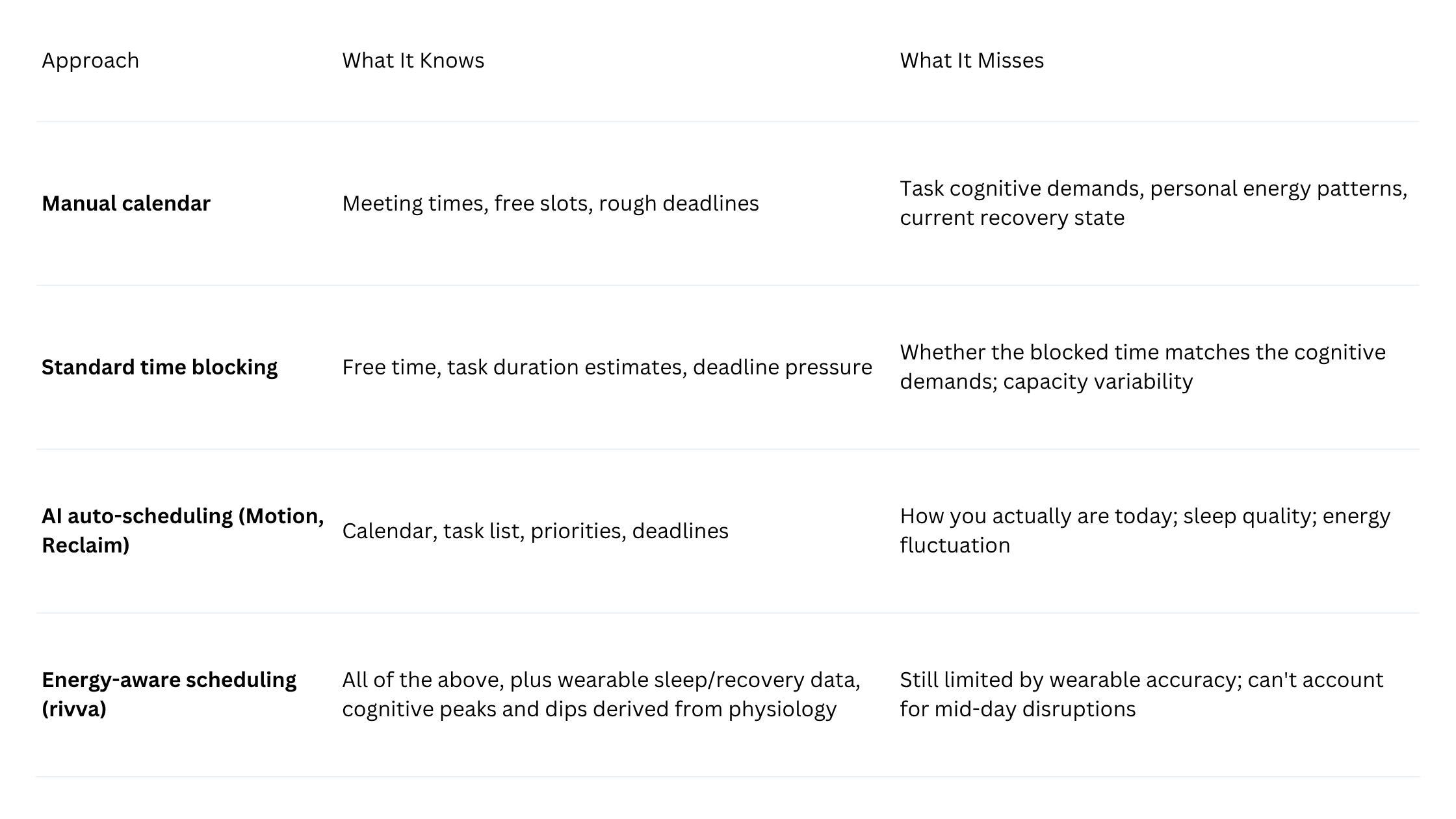
Standard time blocking is a scheduling method, not a capacity method. You look at your calendar, find free time, and assign tasks to those slots based on when they fit.
Time blocking is better than no structure. But it treats all free time as equivalent. A two-hour block on Tuesday morning and a two-hour block on Thursday afternoon after a bad night’s sleep are the same on a calendar; they are not the same in terms of what you can actually do in them.
Energy-aware scheduling adds a layer that time blocking lacks: it asks not just “is this time free?” but “does this time have the cognitive character the task requires?”
How It Differs From Standard AI Scheduling
AI scheduling tools like Motion and Reclaim represent a genuine advance over manual calendar management. They can look at your task list, estimate durations, consider deadlines, and automatically place tasks in available slots.
What they know: your calendar, your task list, your deadlines, your preferences.
What they don’t know: how you actually are today. How you slept. Whether you’re in a cognitive peak or a dip right now. Whether you’re running on four days of poor sleep and your prefrontal cortex is operating at 70%.
This is not a small difference. For people with variable energy — which includes people with ADHD, sleep disorders, chronic illness, high-stress periods, or just the normal variability of being human — scheduling without capacity data means constantly fighting a plan that was made for a version of you that doesn’t always show up.
What Energy Data Actually Looks Like
Sleep stages: Deep sleep is primarily when physical restoration and memory consolidation occur. REM sleep is associated with emotional processing and creative integration. The proportion and quality of these stages affects how restored your brain actually is the following day.
Heart rate variability (HRV): More variation is better — it indicates a healthy, responsive autonomic nervous system in recovery mode. Devices like Oura and Whoop measure overnight HRV and produce a daily readiness score. High scores predict better cognitive performance.
Resting heart rate: Elevated resting heart rate (relative to your baseline) often indicates physiological stress, illness onset, or incomplete recovery.
These data points combined give a readiness picture that is more objective and often more accurate than self-assessment — people are reliably bad at estimating how cognitively impaired they are when they haven’t slept well.
Quick Comparison: Scheduling Approaches
How to Apply Energy-Aware Scheduling Without a Dedicated Tool
Step 1: Track your own energy for a week. Every 90 minutes or so, note your current energy on a simple scale — 1 (low), 2 (medium), 3 (high) — and briefly what you’re experiencing.
Step 2: Map your patterns. After a week, look at your notes. Most people find remarkably consistent patterns: a reliable peak window, a consistent dip, perhaps a secondary peak.
Step 3: Categorize your tasks by cognitive demand. High-demand (deep focus, novel problem-solving), medium-demand (meetings, collaborative work), and low-demand (email, administrative tasks).
Step 4: Match categories to windows. Protect your peak window for high-demand work. Use medium windows for collaborative and meeting-heavy work. Save low-demand tasks for dip windows.
Step 5: Treat the plan as approximate, not fixed. The map gives you direction; it doesn’t give you a rigid script.
Step 6: Review and adjust weekly. The map gets more accurate as you calibrate it with real experience.
How rivva Implements Energy-Aware Scheduling
rivva is built around the principle that your schedule should adapt to your capacity, not ask you to adapt to your schedule.
When you connect a supported wearable — Apple Watch, Oura, Fitbit, or Whoop — rivva reads your overnight sleep and recovery data each morning and constructs an Energy Timeline: a visual map of your predicted cognitive peaks and dips for the day. This timeline is personalized — it’s built from your specific sleep quality, HRV, and recovery scores, not from population averages.
Nia, rivva’s AI assistant, uses this timeline to place your tasks. When you add work to your queue — by typing or voice — Nia schedules hard tasks into your peak windows and lighter work into your dips.
The result is a daily plan derived from how you actually are today, not from a theoretical version of you operating at consistent peak capacity.
FAQ
Q: Does energy-aware scheduling only work for people with ADHD?
No — it’s useful for anyone whose cognitive performance varies meaningfully across the day, which is essentially everyone. The practical value is highest for people with highly variable energy: ADHD, irregular sleep, high-stress work, chronic illness. But even people with relatively consistent energy patterns perform better when they match task type to their natural alertness curve.
Q: How accurate are wearables at predicting cognitive performance?
Reasonably accurate at the population level; somewhat less precise at the individual level for any given day. Treat it as an informed starting point that you can override with your actual experience.
Q: What if my peak is at an inconvenient time?
You can’t always work at your biological peak if your meeting schedule or work environment doesn’t allow it. Even partial alignment — using a 30-minute morning peak before others arrive, or blocking your best window from unnecessary meetings — produces real benefit.
Bottom Line
Scheduling that only thinks in time is scheduling that ignores most of what determines whether work gets done well or not at all. Energy-aware scheduling is the practice of taking that variability seriously: mapping your cognitive peaks and dips, matching task demands to available capacity, and building a day that works with your biology rather than demanding you override it.
Most calendars ask where to put your work. Energy-aware scheduling asks when your brain is actually ready for it.