
Time Blocking vs Energy Scheduling: What’s the Difference?
Time blocking fills your calendar. Energy scheduling fills it with the right work at the right time, and rebuilds your plan when your capacity changes.

Both time blocking and energy scheduling are answers to the same basic problem: you have more to do than you have time for, and left to its own devices your day will fill up with the wrong things.
That’s where the similarity ends. They solve the problem differently, they fail differently, and they suit different kinds of people and work. If you’ve been using one and it isn’t quite working, it’s worth understanding what the other actually offers.
What Is Time Blocking?
Time blocking is a scheduling method in which you assign specific tasks or types of work to specific blocks of time in your calendar. Instead of keeping a to-do list and working from it reactively, you decide in advance when each piece of work will happen.
The core insight is sound: if something isn’t on the calendar, it probably won’t happen. By giving work a specific time home, you reduce the cognitive overhead of deciding what to do next, defend your important work from being crowded out, and create a structure that makes your priorities visible.
Time blocking works particularly well when your days are reasonably predictable and when you have enough calendar control to actually protect the blocks you create. It works less well when your energy fluctuates significantly — because it treats all time as equal, and it isn’t.
A two-hour block from 2 to 4 p.m. on a good day and a two-hour block from 2 to 4 p.m. after a bad night’s sleep are not the same thing. Time blocking has no mechanism to account for that difference.
What Is Energy Scheduling?
Energy scheduling is a method that adds a second dimension to time blocking: cognitive capacity. Instead of only asking “when is this time available?” it asks “when is this time available and what kind of mental state can I reliably expect at that time?”
Your ability to do high-quality, demanding work is not evenly distributed across the day or the week. There are windows when you’re genuinely sharper — when focus comes more easily, when your working memory is more reliable, when starting a hard task doesn’t require extraordinary willpower. And there are windows when you’re in a dip.
Energy scheduling tries to make those patterns visible and use them deliberately. High-demand tasks go in peak windows. Lower-demand tasks go in dip windows. Recovery time between demanding work is built in rather than treated as a luxury.
More recently, tools have begun automating this by pulling in physiological data from wearables — sleep quality, recovery scores, heart rate variability — and using that to model your capacity throughout the day.
The Key Differences
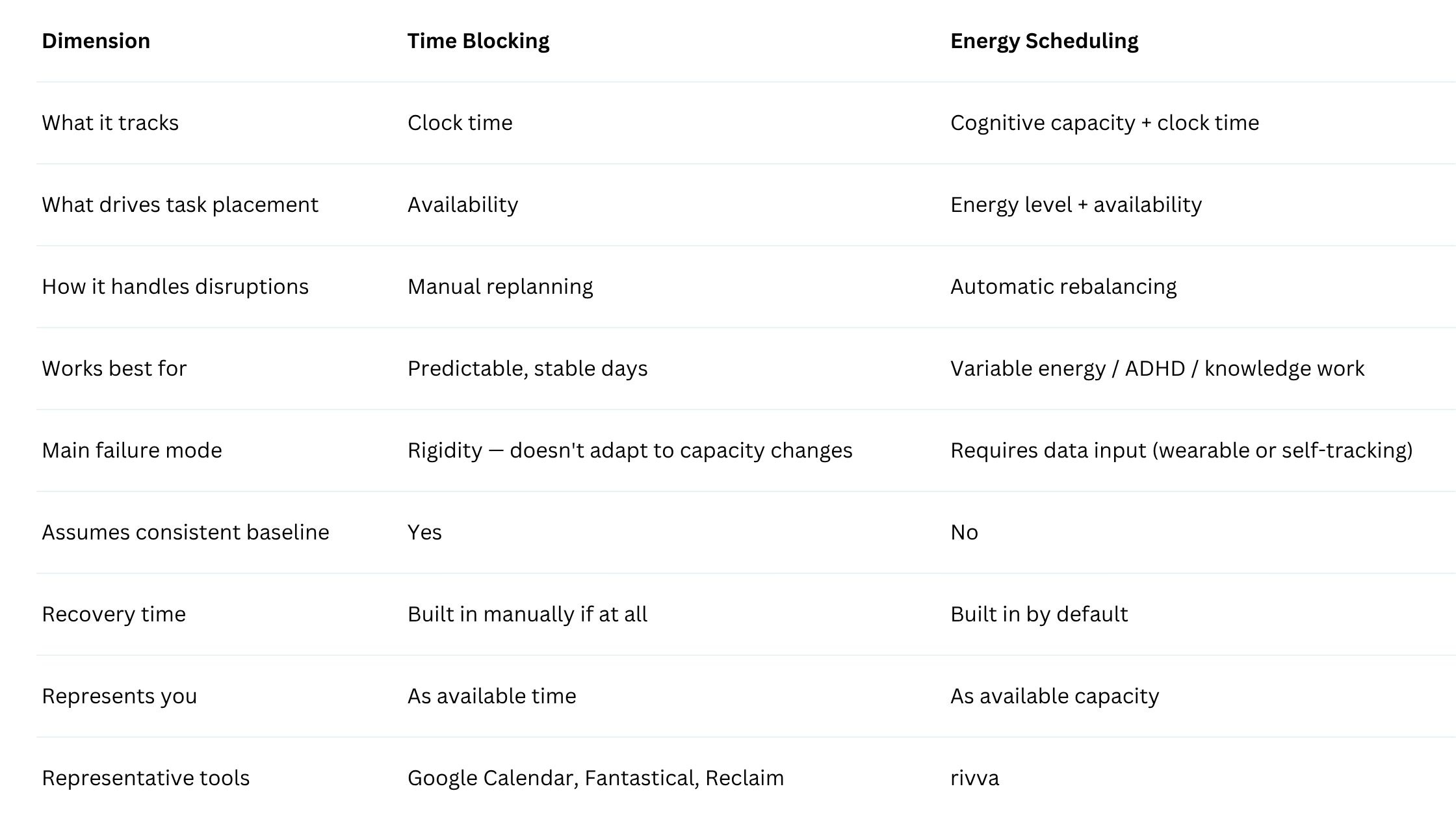
The most important difference is the underlying assumption. Time blocking assumes that a scheduled hour is a usable hour. Energy scheduling assumes that a scheduled hour is usable only if your capacity supports it.
When Time Blocking Is the Right Choice
When your work is relatively predictable. If you broadly know what you’ll be working on week to week, time blocking gives that work a home and protects it from being crowded out.
When your energy is relatively stable. If your energy pattern is consistent and your sleep is generally good, the added complexity of tracking physiological data may not be worth the benefit.
When you need to coordinate with others. Time blocking is visible in shared calendars. Colleagues can see you’re blocked for deep work, and meeting schedulers know when you’re available.
When you’re dealing primarily with a focus problem, not a capacity problem. If the issue is that you’re context-switching too much and need structural protection for important work, time blocking solves that. If the issue is that your capacity itself is the variable, time blocking alone won’t reach it.
When Energy Scheduling Is the Right Choice
When your capacity fluctuates significantly. ADHD, chronic fatigue, variable sleep, hormonal cycles, mental health conditions that affect cognition — if your cognitive availability is genuinely inconsistent day to day, a system that doesn’t account for that is going to fail you regularly.
When you’re doing work where quality depends on cognitive state. A software engineer debugging a complex system, a writer working on a first draft — these tasks have a different quality ceiling at 2 p.m. on a bad day than at 10 a.m. on a good one.
When you’re recovering from burnout. Energy scheduling builds in recovery as a structural element. It doesn’t assume you can run at 100% because you’re not technically sick anymore.
When you have wearable data available. Sleep and recovery data from wearables are surprisingly useful inputs for work scheduling — but only if something uses it.
Can You Combine Them?
Yes — and this is probably the most useful framing.
Think of time blocking as the structure and energy scheduling as the intelligence layer on top of it. Time blocking answers “what goes where and when?” — it gives you the overall architecture of the day. Energy scheduling answers “does this task belong in this window given how I’m actually doing today?”
In practice: time blocking creates the protected windows. Energy scheduling determines what goes into each window based on your capacity. On a good day, you put high-demand tasks in your morning block and medium-demand work in the afternoon. On a bad day, your energy scheduling layer shifts the high-demand work to another window and fills today’s morning block with tasks your current capacity can support.
Time is the container. Capacity determines what the container can hold.
Frequently Asked Questions
Can I use time blocking with ADHD?
You can, and many ADHD people do. The challenge is that time blocking doesn’t account for variable initiation, inconsistent alertness, or the energy cost of task switching, all of which are pronounced with ADHD. The results tend to improve significantly when energy scheduling principles are layered on top.
Doesn’t energy scheduling just give me an excuse to avoid hard work?
The way to guard against this is with honest data — either self-tracked over time or from wearables — rather than moment-to-moment feelings. If you’re designating the entire day as a dip every day, that’s a different problem.
What do I do when my energy peaks don’t match when my meetings are?
Protect what you can, accept what you can’t, and batch what’s movable. Even 45–60 focused minutes at a slightly suboptimal time is better than nothing.
Is energy scheduling the same as “working with your chronotype”?
Related, but not the same. Chronotype describes your natural tendency toward morning or evening alertness. Energy scheduling is broader: it incorporates sleep quality from night to night, recovery levels, stress, and other real-time variables. Knowing you’re a night owl tells you something about your average peak window. Wearable data tells you where your peak actually is today.
Bottom Line
Time blocking is a solid, practical tool. If it’s working for you, there’s no reason to abandon it. Understanding energy scheduling doesn’t require you to start over — it requires you to add one layer to what you’re already doing: ask not just when work is scheduled, but whether your capacity at that time matches what the work requires.
If your days are predictable and your energy is relatively stable, time blocking probably has what you need. If your capacity fluctuates, adding an energy layer to your time-blocked calendar is likely to produce noticeably better results than either approach alone.
The goal is the same: a day where the right work happens. The question is just which tools get you there given the brain you’re actually working with.