
The Triple-Peak Workday: Why 20% of Professionals Are Essentially Working Two Days in One
1 in 5 workdays follows a triple-peak pattern with an evening work surge. New data reveals when this intense schedule works and when it leads to burnout.

Your morning is productive. You power through the afternoon dip. Then, after dinner, you’re back at your laptop for another focused push. By the time you close your computer around 10pm, you’ve essentially worked two full days compressed into one.
This isn’t occasional crunch time. For a growing number of professionals, it’s becoming the default work pattern.
New data from Hubstaff’s 2026 Global Work Index reveals that about 1 in 5 weekdays (20%) now follows what researchers call a “triple-peak” pattern: a strong focus window in mid-morning, another push after lunch, and then a third surge of productivity after dinner.
These aren’t normal workdays stretched a bit longer. Triple-peak days are fundamentally different in structure, intensity, and sustainability. Understanding the pattern matters because the line between “powerful flexibility” and “always-on burnout culture” is thinner than most leaders realize.
What Triple-Peak Workdays Actually Look Like
Daniel Pink’s research on timing identifies three daily stages most people experience: peak (morning high), trough (afternoon dip), and recovery (late afternoon rebound). The triple-peak workday takes that pattern and adds a fourth stage: a second major push in the evening, typically after dinner.
Here’s what the data shows about these intense days:
Peak 1 (Morning Focus): A strong concentration window in mid-morning, typically 9-11am. This is when cognitive performance is highest for most people.
Peak 2 (Afternoon Work): Another productive push after lunch, usually 1-4pm. Energy is lower than morning but still sufficient for meaningful work.
Peak 3 (Evening Surge): A smaller but distinct third wave of activity after dinner, typically 7-10pm. This is what makes the pattern distinctive.
Across Hubstaff’s dataset, about 20% of all weekdays (Monday through Friday) show this triple-peak activity pattern. That’s roughly one day per week for the average worker, though for some roles and individuals, it’s far more frequent.
The Numbers: Intense, Not Just Long
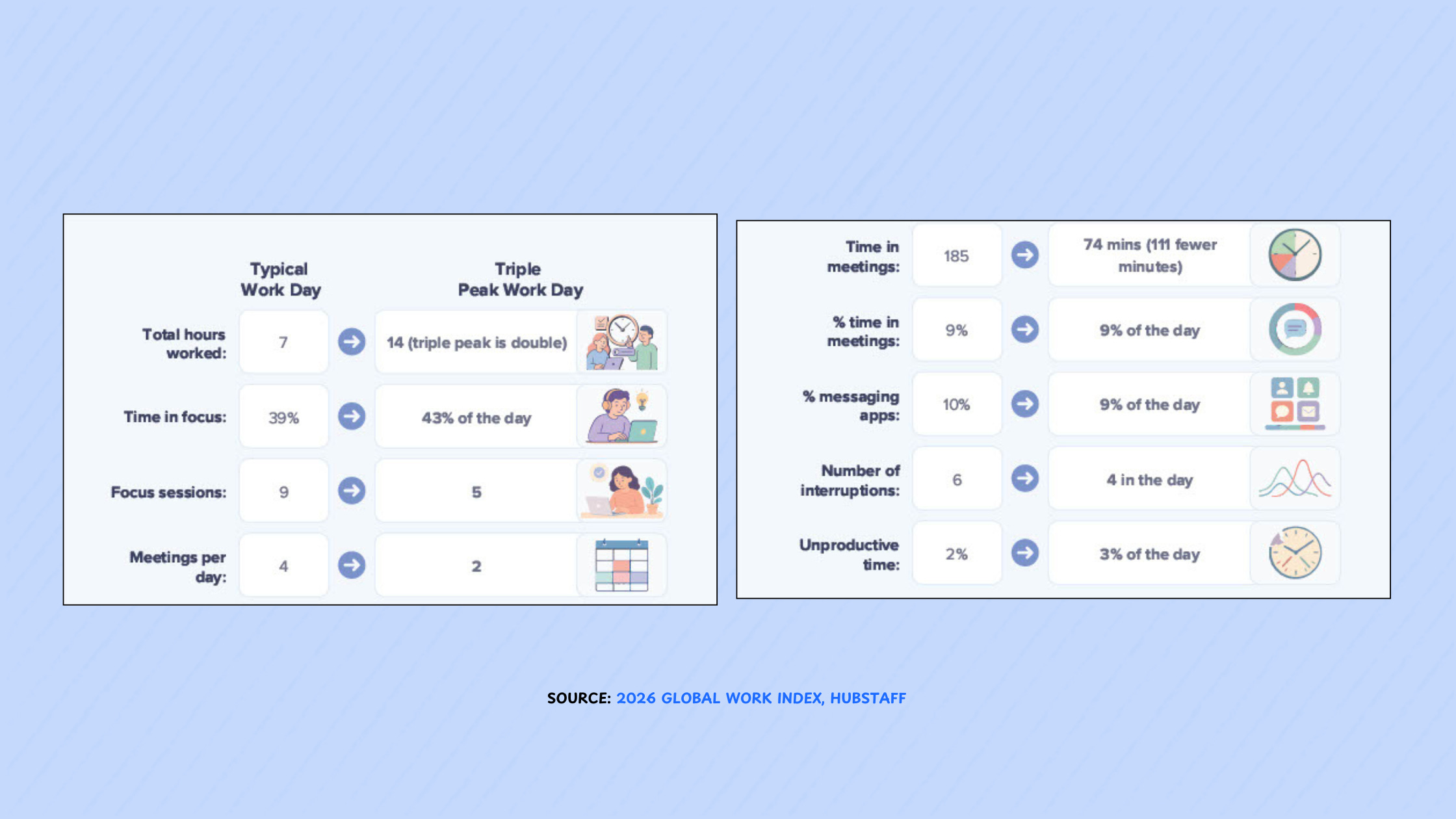
Comparing a typical workday with a triple-peak day reveals just how different these patterns are:
Total Hours Worked
Typical day: 7 hours
Triple-peak day: 14 hours (exactly double)
Time in Focus
Typical day: 39% (about 2.7 hours of actual focused work)
Triple-peak day: 43% (about 6 hours of focused work)
Number of Focus Sessions
Typical day: 9 distinct focus periods
Triple-peak day: 5 focus periods (fewer but much longer)
Meetings
Typical day: 4 meetings, 185 minutes total
Triple-peak day: 2 meetings, 74 minutes total (111 fewer minutes)
Time in Meetings
Typical day: 9% of the day
Triple-peak day: 9% of the day (similar percentage, but spread over more hours)
Communication/Messaging
Typical day: 10% of time
Triple-peak day: 9% of time
Interruptions
Typical day: 6 interruptions
Triple-peak day: 4 interruptions (in the core day window)
Unproductive Time
Typical day: 2%
Triple-peak day: 3% (slightly higher)
The pattern is clear: triple-peak days offer significantly more total focused work (6 hours vs. 2.7 hours), achieved through longer uninterrupted blocks and fewer meetings. But they also cost more: you’re working double the hours, and that extra 1% unproductive time adds up when you’re putting in 14-hour days.
Why Triple-Peak Days Happen
The data reveals why people are pushing work into evening hours, and it’s not what you might assume. It’s not primarily about deadlines or being behind schedule. It’s about reclaiming the uninterrupted focus time that’s impossible to find between 9am and 5pm.
Fewer meetings means more focus: Triple-peak days show half as many meetings (2 vs. 4). When your core hours aren’t fragmented by meetings, you can actually get into flow state. Some people are deliberately blocking out 3-6pm for life (school pickup, gym, errands), then logging back in after dinner to do deep work in peace.
Longer focus blocks enable better work: Instead of 9 short focus sessions scattered across the day, triple-peak days show 5 longer sessions. These extended blocks are when real progress happens: writing that requires sustained thought, complex problem-solving, strategic planning, creative work.
Evenings offer the quiet that days lack: No Slack pings. No “quick sync” requests. No ambient office interruptions. After dinner, people often have the uninterrupted time they couldn’t find during business hours.
This aligns perfectly with Pink’s research on timing: when the timing fits the task and matches individual energy patterns, performance can boost significantly. For some people, that evening block is their second wind when they do their best creative thinking.
When Triple-Peak Works (Deliberate Flexibility)
Used well, the triple-peak pattern represents exactly the kind of flexibility that makes modern work valuable. Here’s when it works:
You’re optimizing around life, not just work. Someone blocks out 3-6pm for school pickup, a workout, medical appointments, or caring for family. Then they log back in after dinner to complete work during hours that fit their schedule. This is work-life integration done right.
You’re matching work to your personal energy patterns. Not everyone is a “morning person.” Some people genuinely think better at night. If someone’s circadian rhythm means their creative peak happens at 8pm, letting them work then (and start later) is smart management, not a problem.
The evening work is truly optional. The person chooses to do a third push because they’re in flow, excited about the project, or prefer to finish something rather than leave it hanging. There’s no expectation or pressure from leadership.
There are clear boundaries. The person knows exactly when to stop, takes real weekends, and isn’t consistently working triple-peak days week after week. It’s occasional, deliberate, and sustainable.
You’re getting more total focused work. Triple-peak days deliver 6 hours of focus vs. the typical 2.7 hours. If someone uses that extra focus time for high-impact work and feels energized rather than drained, it’s a net positive.
When Triple-Peak Fails (Always-On Culture)
Used badly, the same pattern becomes an unsustainable grind that fuels burnout and sets impossible expectations. Here’s when it’s a problem:
People are online early, stuck in meetings all day, then expected to “catch up” at night. This isn’t flexibility, it’s an infinite workday. The morning and afternoon aren’t productive because they’re consumed by meetings and coordination. The evening surge isn’t a choice, it’s the only time actual work can happen.
There’s implicit or explicit pressure to be available. When leadership regularly sends messages at 9pm or schedules “optional” calls after hours, people read between the lines. The third peak becomes expected, not a personal choice.
It’s happening consistently, week after week. Occasional triple-peak days driven by genuine deadlines or personal preference are fine. But when someone’s baseline is 14-hour days most of the week, that’s not sustainable. The data shows unproductive time already creeps up 50% on triple-peak days (3% vs. 2%). Compound that over weeks and burnout is inevitable.
People can’t disconnect. When your work rhythm includes an evening surge “just in case something comes up,” you’re not giving your brain the recovery time it needs. Cognitive performance depends on real rest, not just shifting from one task to another.
The quality of evening work suffers. That 3% unproductive time in triple-peak days is a warning sign. You don’t double the length of a workday without adding drag. Fatigue affects judgment, increases errors, and reduces creative thinking. Working more doesn’t mean producing more.
The Health and Performance Trade-Off
Research from the World Health Organization and Stanford paints a clear picture of what happens when long hours become the norm:
The WHO found that working 55+ hours per week leads to a 35% higher risk of stroke and 17% higher risk of heart disease compared to a standard 35-40 hour work week.
Stanford research shows that beyond about 55 hours, there’s virtually no additional output, just more fatigue and errors. You’re trading health for an illusion of productivity.
Triple-peak days land squarely in this danger zone when they become frequent. At 14 hours per day, even three triple-peak days per week puts you over 50 hours. Add a few normal 7-hour days and you’re well past Stanford’s productivity cliff and into WHO’s health risk territory.
The data from Hubstaff shows that while focus percentage is slightly higher on triple-peak days (43% vs. 39%), the absolute exhaustion from 14-hour days means that advantage disappears fast when the pattern repeats.
What Leaders Should Do
The right response isn’t to ban evening work or pretend triple-peak days don’t happen. It’s to make them optional and sustainable:
Make expectations explicit
If your culture supports flexible work hours, say so clearly. “We support people working when they’re most productive, whether that’s early morning or late evening. We don’t expect responses outside your chosen hours.”
If evening work is truly optional, prove it: don’t promote based on who’s online at 9pm, don’t let “always available” become the unwritten standard for advancement.
Track the pattern, not the hours
Don’t just look at total hours worked. Look at how often individuals are running triple-peak patterns. If someone occasionally does it (once or twice a month), that’s fine. If it’s weekly or daily, investigate:
Are they overwhelmed with work?
Are meetings consuming their core hours?
Do they feel pressure to be always available?
Would adjusting their core hours help?
Protect core hours for deep work
The reason triple-peak days work at all is because they offer fewer meetings and more focus blocks. If you protected those same conditions during the 9-5 window, people wouldn’t need the evening surge.
Enforce maker-time rules: 9-11am sacred for focus, first meeting no earlier than 11:30am, no recurring meetings stacked in ways that fragment the day.
Design for recovery
If someone’s putting in triple-peak days during a launch or deadline, actively plan recovery time afterward. Lighter weeks, no-meeting days, or explicit permission to start late the following week.
Treat the evening surge as borrowing against future capacity. Make sure you’re paying it back.
Use tools that show the pattern
Most calendars and time trackers show hours worked, but not work patterns. Use tools that reveal when people are actually doing focused work vs. being online.
Tools like rivva show you energy patterns and focus distribution across the day. If you see someone consistently shifting deep work to evenings, that’s a signal their daytime schedule needs fixing.
The Bottom Line: Optional, Not Expected
Triple-peak workdays are real, intense, and can be powerful when they’re deliberate and occasional. They offer roughly double the focus time of a typical day by reducing meetings and creating longer uninterrupted blocks.
But they’re also exhausting. Unproductive time creeps up even on these focused days, and the health risks of consistent 50+ hour weeks are well documented.
Where we land is simple: the third peak should be optional, not expected.
When used as genuine flexibility (blocking mid-day for life, then finishing work later), it’s exactly the autonomy that modern work promises. When it becomes implicit expectation (meetings all day, “catch up” at night), it’s burnout disguised as productivity.
The leaders who win in 2026 will be the ones who design systems that protect focus time during core hours so the evening surge becomes a choice, not a necessity.
Want to protect your peak hours and make evening work optional? rivva schedules your most important work when you’ll have the energy to do it well, so you’re not pushing everything to nights and weekends. Try it free for 7 days at www.rivva.app