
Clockwise Shut Down: The Best Alternatives in 2026
Clockwise shut down in March 2026. If you were using it for AI-powered calendar management and meeting optimisation, you are now looking for a replacement.

This post covers what Clockwise was good at, what to look for in an alternative, and the best options available in 2026.
What Clockwise Did Well
Before looking at alternatives, it is worth being clear about what Clockwise actually solved.
Clockwise’s core value was calendar defragmentation. It would move flexible meetings and Focus Time blocks around on your calendar to create longer stretches of uninterrupted work. If you had a 30-minute meeting at 10am and another at 2pm, Clockwise would try to move one of them so you had a longer block free for deep work.
It worked well for:
Knowledge workers with collaborative calendars and a lot of meetings
Teams that wanted to protect individual focus time without manual blocking
People whose days were fragmented by meetings that could theoretically shift
Where it fell short:
It only managed your calendar. It did not help with tasks, priorities, or what to actually work on in the focus time it created.
It required buy-in from the whole team to work well as a collaborative tool.
It did not account for personal energy. A 2-hour focus block at 3pm is not the same as a 2-hour focus block at 10am.
If you are looking for a like-for-like replacement, you want something that handles scheduling around focus time. If you are looking for something that goes further, you want a tool that also handles tasks, priorities, and personal energy.

The Best Clockwise Alternatives in 2026
1. rivva (Best for energy-aware planning and ADHD users)
Best for: Knowledge workers, ADHD users, anyone whose energy varies significantly through the day.
rivva is an AI daily planner that schedules your tasks around your energy, not just your calendar. Where Clockwise once protected blocks of time on your calendar, rivva fills those blocks with the right work — based on your energy level, your task priority, and how long things actually take.
How it differs from Clockwise:
Clockwise optimised your calendar. rivva optimises your day. The distinction matters because an empty calendar block does not tell you what to do in it, and doing hard work in a low-energy window is not actually better than having the meeting.
rivva connects to your Google or Outlook calendar and your wearable (Apple Watch, Fitbit, Oura, Whoop) to build a daily Energy Timeline. Deep work is scheduled during your peak windows. Admin and lightweight tasks fill your dips. Your most important work never lands when your brain is already running low.
Standout features for ex-Clockwise users:
Auto-scheduling that places tasks in calendar blocks (what Clockwise left empty, rivva fills)
Nia, an AI assistant that helps you decide what to work on, breaks tasks down, and rebuilds your plan when things go sideways
Routines that time-block automatically every day
The planner adapts in real-time when meetings shift or tasks take longer than expected
What you give up: Clockwise was built for teams. rivva is focused on the individual. If calendar defragmentation for a whole team is what you need, rivva is not that.
rivva is free to try. No credit card required.
Try rivva at rivva.app
2. Reclaim.ai (Closest like-for-like replacement)
Best for: Teams who want calendar defragmentation and habit scheduling.
Reclaim is probably the closest like-for-like alternative to Clockwise. It moves flexible tasks and Focus Time blocks to create clear work windows on your calendar, working across team calendars the way Clockwise did.
Reclaim also introduced “habits” — recurring blocks (gym, lunch, deep work) that the system tries to protect as meetings fill in around them.
What it does well: Team-aware scheduling, smart meeting rescheduling, habits, integration with Asana, Linear, and Jira.
What it lacks: It does not account for personal energy. Blocks are scheduled by time, not by cognitive load or your personal rhythm. It also doesn’t include an AI assistant for task management.
If you specifically need the team scheduling features that Clockwise had, Reclaim is your best option.
3. Motion (Best for automated task scheduling)
Best for: Anyone who wants AI to schedule tasks as well as meetings.
Motion builds a daily schedule by combining your meetings and your tasks into a single auto-managed calendar. You add a task with a deadline, and Motion decides when to work on it based on what else is on your calendar.
What it does well: It treats tasks and meetings as first-class calendar objects. Good for people with many deadlines across multiple projects.
What to watch for: Motion can over-schedule. It tends to fill every available slot, which leaves no buffer and no recovery time. Users with ADHD or variable energy often find this creates anxiety rather than relieving it. rivva takes a different approach and builds recovery into the schedule by default.
4. Notion Calendar (Best if you are already in Notion)
Best for: Notion users who want calendar and docs in one place.
Notion Calendar is a standalone calendar app from Notion. It is simpler than Clockwise, but it integrates cleanly with Notion pages and databases, which is useful if your project work already lives there.
It does not offer AI scheduling. It is a clean, fast calendar client, not a planning tool. Worth considering if the Clockwise team integration was not the part you needed — if you just wanted a better calendar view.
5. Cal.com (Best for scheduling links and booking)
Best for: People who used Clockwise primarily for its scheduling links feature.
Clockwise had a scheduling links feature that let contacts book time in your calendar without back-and-forth. If that was the main thing you used, Cal.com is a good open-source replacement. rivva also offers scheduling links if you want this within the same planning tool.
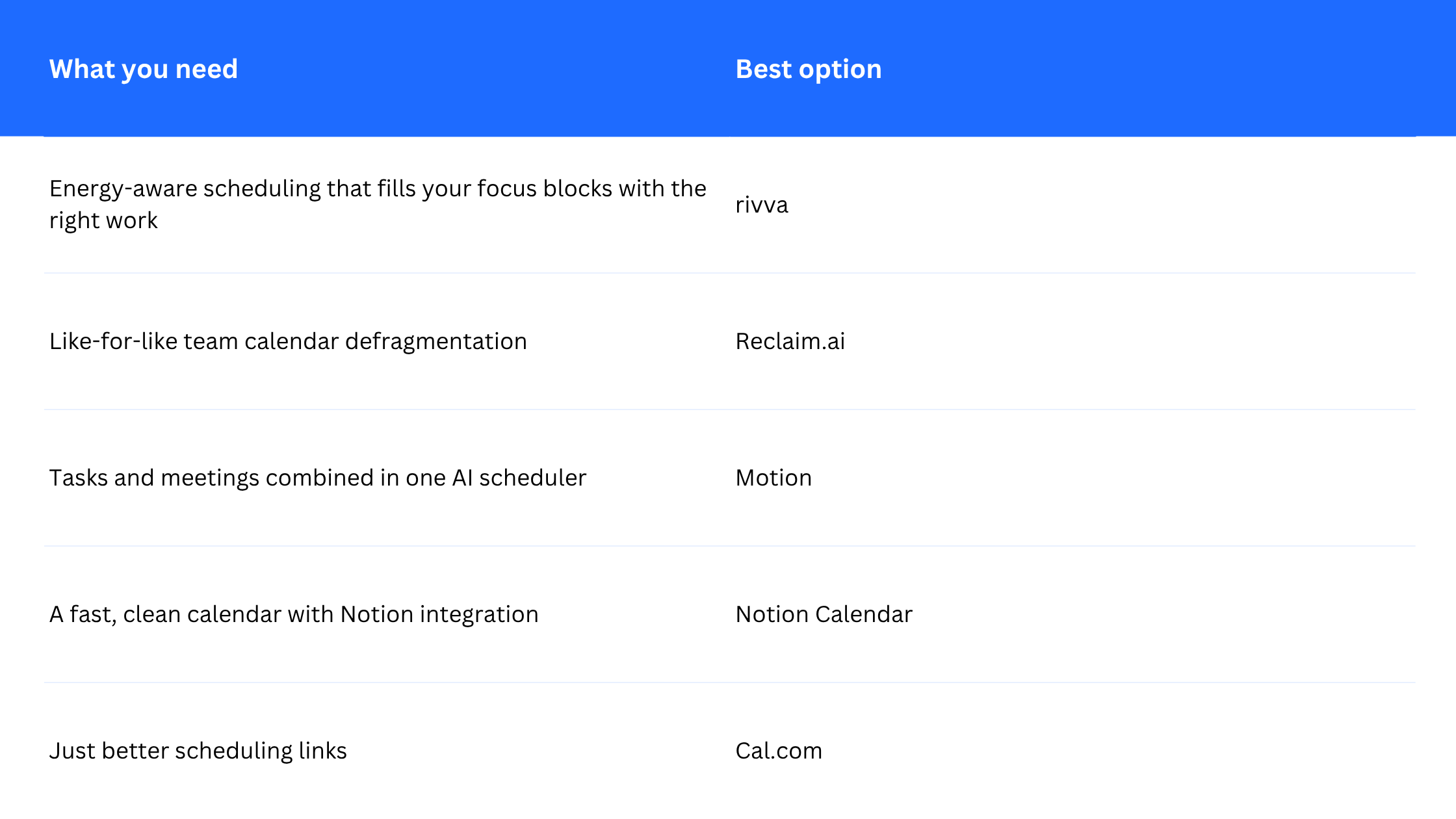
How to Choose based on What you Need
Frequently Asked Questions
Why did Clockwise shut down?
Clockwise announced they were winding down operations in March 2026. The company did not publish a detailed explanation publicly. The space has become more competitive as larger players and newer AI tools absorbed the market.
Will my Clockwise data be available?
Clockwise allowed users to export their data before shutdown. If you did not export your data before the service ended, the history is likely no longer available.
Can rivva do everything Clockwise did?
rivva handles the individual planning side of what Clockwise offered, and goes deeper on task management, AI assistance, and energy-aware scheduling. What rivva does not replicate is the team-level calendar optimisation where Clockwise would coordinate schedules across a whole team. For that, Reclaim is the closer match.
Is rivva suitable for ADHD users who used Clockwise?
Yes. rivva was built with neurodivergent users in mind. Features like Replan, Rebuild My Day, and Reset are designed specifically for the kinds of planning challenges ADHD creates. The auto-scheduling means you are not deciding what to work on in each focus block — rivva handles that for you.
If you are looking for the best Clockwise alternative in 2026, rivva is the one that goes furthest beyond what Clockwise offered. Free to try, no credit card, setup in under 10 minutes.
Compare rivva to other tools at rivva.app/compare .