
Why the Average Worker Gets Only 2-3 Hours of Focus Time Each Day (and How to Reclaim It)
New data reveals workers average only 2-3 hours of focus time daily. Discover why deep work is disappearing and how to protect your most productive hours in 2026.

You start your day with good intentions. Email first thing, then that strategic project you’ve been pushing back all week. Two hours later, you’ve attended a standup, answered Slack messages, switched between seven different apps, and made zero progress on anything that actually matters.
Sound familiar? You’re not alone. New data from Hubstaff’s 2026 Global Work Index, analyzing 140,000 workers across 17,000 organizations, reveals something most of us suspected but couldn’t quantify: the average worker gets only 39% of their day in deep focus. That’s roughly 2-3 hours of real, uninterrupted productive work out of an 8-hour day.
The rest disappears into meetings, messages, context switching between tools, and what researchers call “work about work.” And it’s getting worse.
What the Data Shows
Focus time is uninterrupted productive activity inside work apps, long enough to actually make progress on meaningful tasks. Not checking Slack. Not skimming email. Not switching between browser tabs. Actual concentrated work.
Across Hubstaff’s dataset, here’s what focus time looks like by role and work style:
By workstyle:
Office-based teams: 45% focus time (highest)
Remote teams: 41% focus time
Hybrid teams: 31% focus time (lowest)
By role:
High-focus roles (engineers, designers, analysts, writers): 40-44% focus time (about 2-3 hours daily)
Collaborative roles (product managers, marketing managers, founders): 1-2 hours focus time daily
Managers and team leads: Focus drops into the mid-20% range
Let that sink in. If you’re a manager or founder, you’re getting maybe 90 minutes of focused work per day. The rest is coordination, communication, and context switching.
Hybrid workers have it worst. They’re getting squeezed from both sides: office days bring meeting overload, remote days bring communication overhead to compensate for not being physically present. The result is the lowest focus time of any work arrangement.
Why Focus Time Is Disappearing
The problem isn’t that people are lazy or undisciplined. Three structural forces are systematically destroying focus time:
Meetings Are Eating the Day
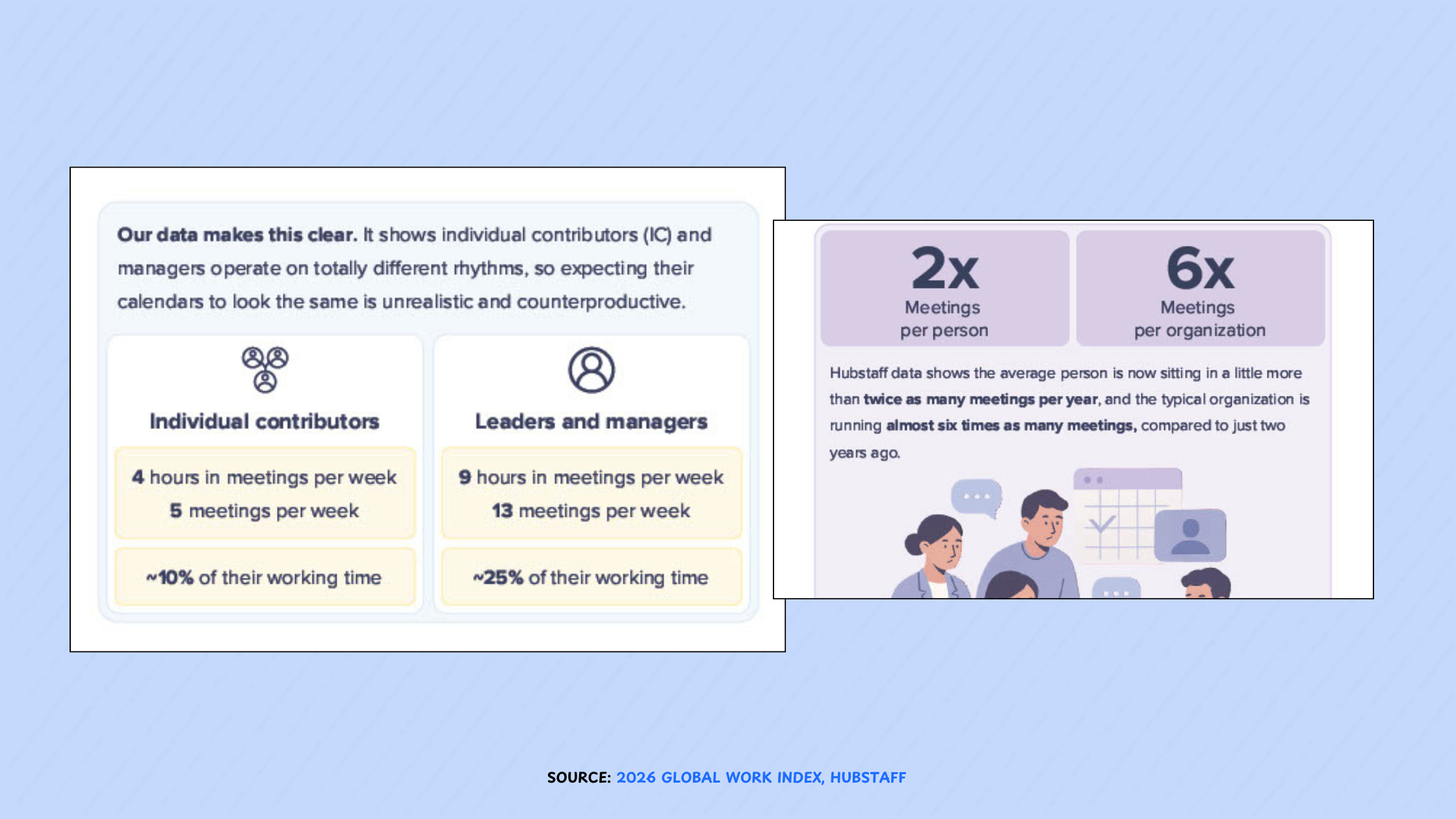
The typical worker now sits in about 4 meetings per day, spending roughly 185 minutes in meetings. That’s over 3 hours. Managers average 9 hours in meetings per week (13 meetings). Individual contributors average 4 hours per week (5 meetings).
But the real problem isn’t just the meeting time itself. It’s how spread out those meetings are.
Hubstaff data shows that every single hour between 9am and 5pm carries a meaningful share of meeting time. There’s no “meeting block” followed by long quiet stretches. Instead, you get a standup at 9am, a sync at 11am, a review after lunch, a check-in at 3pm. Each meeting fragments your day into chunks too small for deep work.
And this contradicts what productivity research says works best. According to Microsoft’s Work Trend Index, roughly half of all meetings cluster in mid-morning and early afternoon, exactly when people say they’d rather be doing focused work.
Maker-time (9:00-11:00am) should be sacred with no recurring meetings.
But in reality, 26% of all meeting minutes happen during that 9-11am window. We’re spending a quarter of our meeting time during the hours when our brains work best.
Tool Overload and the Toggle Tax
The average person now uses 18 different apps per day to get work done. That number climbs dramatically for certain roles:
Office-based teams: 23 apps per day
Marketers: 24 apps per day
SEO specialists: 36 apps per day
Each switch between tools comes with a cognitive cost that Harvard Business Review calls the “toggle tax.” Their research found that digital workers toggle between applications and websites nearly 1,200 times per day, spending almost 4 hours per week just reorienting themselves after each switch.
That’s 9% of working time lost to context switching. And that’s before you factor in the decision fatigue, errors, and difficulty getting back into flow state that comes with constant app-hopping.
Think about your typical work pattern: you’re drafting something in Google Docs, a Slack notification pulls you away, you check your project management tool to see what’s urgent, hop to email to respond to something, back to Docs but now you’ve lost your train of thought. Five minutes and four apps later, you’re starting over.
Multiply that by dozens of times per day and you see why focus time is evaporating.
The Hybrid Work Squeeze
Hybrid work should offer the best of both worlds: office collaboration when needed, remote focus when required. Instead, the data shows hybrid workers getting the worst of both.
Hybrid teams clock only 31% focus time compared to 45% for office teams and 41% for remote teams. Why?
Office days bring back-to-back meetings and ambient interruptions. Remote days require over-communication to compensate for lack of physical presence. You’re on Zoom more, posting updates more, checking Slack more, because you need to prove you’re actually working when people can’t see you.
The flexibility that hybrid work promises gets eaten by coordination overhead that neither fully remote nor fully office teams face.
The Real Cost of Lost Focus
When most of your day is fragmented into 15-30 minute chunks between meetings and interruptions, several things happen:
Quality drops: Deep work requires sustained attention. Strategic thinking, complex problem-solving, creative work, and learning all need uninterrupted blocks of time. When you only get 30 minutes here and 45 minutes there, you’re stuck in shallow work: email, admin, quick responses, surface-level thinking.
Everything takes longer: Context switching isn’t free. Research from the University of California Irvine shows it takes an average of 23 minutes to fully refocus after an interruption. If you’re interrupted every 30 minutes, you’re spending more time recovering from interruptions than actually working.
Burnout accelerates: Constant context switching and decision fatigue (what to work on, where to find things, what to respond to first) drain mental energy faster than the actual work. You end the day exhausted but feeling like you accomplished nothing meaningful.
Important work gets pushed to evenings and weekends: Hubstaff’s data on triple-peak workdays reveals that about 20% of workers are essentially working two days in one, with a third surge of productivity after dinner. Why? They’re reclaiming the uninterrupted time they couldn’t find during the 9-5 window.
How Different Roles Protect Focus Time
Not everyone’s focus time is equally damaged. Looking at the role-based differences reveals what’s actually working:
Engineers and analysts (40-44% focus time) typically have:
Clearer boundaries around maker time
Work that’s harder to interrupt (you can’t write code in 15-minute chunks)
Tools designed for deep work
Managers and founders (20-30% focus time) typically face:
Coordination as their primary job function
More meetings by necessity
Constant interruptions (they’re the escalation point)
Cultural expectation of availability
The takeaway isn’t that managers should have more focus time (coordination is part of their role), but that organizations need to acknowledge these patterns and design accordingly. Managers need protected time for strategic thinking. Individual contributors need their mornings defended.
Reclaiming Your Focus Time: Strategies That Actually Work
Based on the data and what high-focus teams are doing differently, here’s what works:
1. Protect Morning Maker Time as Sacred
The 9-11am window is when most people’s cognitive performance peaks. Protect it ruthlessly. No recurring meetings. No Slack check-ins. No “quick syncs.”
High-focus teams in the Hubstaff data enforce this as a hard rule: first meeting no earlier than 11:30am. Anything before 9am or after 6pm treated as rare exceptions.
2. Batch Meetings into Designated Windows
Don’t let meetings spread across your entire day. Cluster them into specific windows: early afternoon (1-3pm) and late afternoon (3-5pm). This creates longer uninterrupted stretches before and after.
The data shows that teams with tighter meeting clustering maintain higher focus percentages. When meetings are scattered, focus never gets started.
3. Reduce Your Tool Stack to a Clear Digital Spine
Audit your team’s app usage. Identify teams in the top decile of app counts and compare their focus time to teams with leaner stacks. You’ll likely see that extreme tool counts correlate with reduced focus.
Build a simple “tool-for-what” map:
One tool for communication (Slack)
One tool for work/tasks (your planner)
One tool for documentation (Notion, Google Docs)
One tool for projects (Asana, Linear)
Clear defaults reduce context switching. Everyone knows where to put work and where to look for it.
4. Track Focus Time as a Team-Level KPI
You can’t improve what you don’t measure. Start tracking focus percentage and absolute focus hours per week by team and role.
Set realistic benchmarks based on the Hubstaff data:
Engineers/analysts: aim for 40%+ focus time
Collaborative roles: 30-35% is realistic
Managers: 20-25% (coordination is the job)
When focus erodes below these thresholds, treat it as a capacity problem and intervene: rescope work, reduce meeting load, consolidate tools.
5. Use Energy-Aware Scheduling
Not all hours are equal for focus work. Your 9am brain is different from your 3pm brain. Schedule demanding work during peak cognitive hours, lighter work during afternoon dips.
Tools like rivva take this approach by scheduling tasks based on when you’ll actually have the mental energy to do them well, not just when your calendar is empty. Deep work gets your morning peak hours automatically. Admin work goes to low-energy periods.
This is the only way to actually protect focus time in practice, not just in theory.
What This Means for How We Work in 2026
The organizations that thrive over the next few years will be the ones that treat focus time as a first-class metric, not an afterthought.
That means:
Designing meeting schedules around focus time, not the other way around
Treating 9-11am as sacred maker time by default
Streamlining tool stacks to reduce context switching
Setting role-appropriate focus time benchmarks
Using AI to handle scheduling decisions that currently fragment attention
The data is clear: we’re in a focus time crisis. The average worker is down to 2-3 hours of real productive time per day, with the rest consumed by coordination overhead.
But it doesn’t have to be this way. The same data shows what works: protected morning blocks, clustered meetings, leaner tool stacks, and intelligent scheduling that respects human cognitive capacity.
Focus time isn’t a luxury. For knowledge workers, it’s where actual value gets created. Everything else is just overhead.
Ready to reclaim your focus time? rivva automatically protects your peak hours for deep work and schedules tasks when you’ll actually have the energy to do them well. Try it free for 7 days at www.rivva.app