
ADHD and Time Blocking: Why It Fails and What Works
Time blocking is the most recommended system for ADHD — and the one most likely to increase guilt and paralysis. Here's what actually helps instead.

Time blocking is the most recommended system for ADHD — and the one most likely to increase guilt and paralysis. Here’s what actually helps instead.
Every productivity article about ADHD eventually recommends the same thing: time blocking. Structure your day into named chunks. Put each task in a box. Know exactly what you’re doing at 2pm on Tuesday. The logic is sound — ADHD brains struggle with time blindness, decision fatigue, and prioritization, and time blocking addresses all three on paper.
The problem is that it works in theory and falls apart in practice with remarkable consistency. Not because the people using it aren’t trying hard enough. It fails because the model that time blocking is built on — a day that unfolds predictably, with consistent energy, and transitions that happen on command — is almost the opposite of how an ADHD brain actually moves through a day.
Why Time Blocking Gets Recommended for ADHD
It Externalizes the Structure Your Brain Doesn’t Naturally Generate
One of the core difficulties in ADHD isn’t lack of intelligence or motivation — it’s inconsistent access to working memory and executive function. Time blocking removes the in-the-moment decision. You don’t have to choose what to do at 2pm — you already decided at 9am, in a lower-pressure moment. That’s a real benefit.
It Makes Time Visible
Time blindness is one of the most practically disruptive features of ADHD. ADHD brains often exist in two categories: now, and not now. Time blocking, laid out visually on a calendar, attempts to convert abstract time into something you can see and navigate.
It Reduces Decision Fatigue
Decision fatigue is a real phenomenon. For ADHD brains, where every decision may require a disproportionate amount of executive effort, this compounds fast. A well-constructed time-blocked plan theoretically eliminates most micro-decisions.
Why It Fails in Practice
The Plan Assumes Consistent Capacity It Never Has
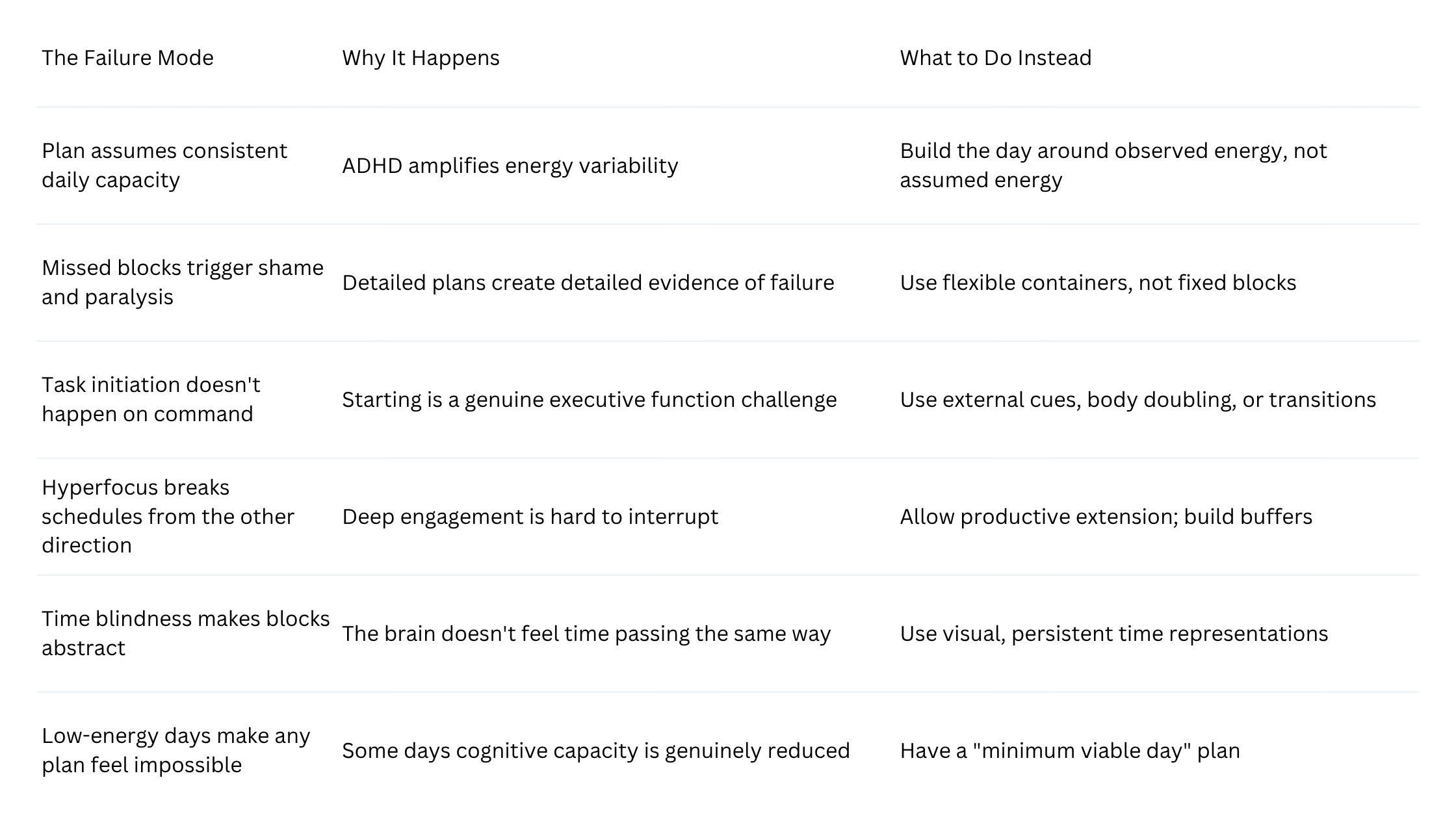
A time block says: from 9am to 11am, you will do deep work on this project. That block doesn’t know how you slept. It doesn’t know that today is one of those low-regulation days where starting anything feels impossible. The block just sits there, demanding the same output regardless of what you actually have available.
ADHD significantly amplifies the variability. Sleep quality, emotional state, stimulation levels, time of day — all of these swing cognitive availability much more dramatically than the productivity literature acknowledges.
Failed Plans Create Shame, Shame Creates Paralysis
The damage from a broken time-blocked plan isn’t just that the work didn’t get done. When you don’t follow your 9am–11am block, the block doesn’t disappear. At 11:30am, you’re not just behind on work — you’re also managing the emotional weight of having failed at the system you built to help yourself. That shame is not a minor thing. For many ADHD people, it triggers a kind of paralysis where the awareness of how far behind they are actively prevents them from starting.
The more detailed and carefully constructed the original plan, the worse this effect is.
ADHD Brains Struggle With Transitions Into Scheduled Work
Task initiation is one of the core impairments in ADHD. Starting a task — especially a cognitively demanding task — requires activation that doesn’t come automatically. Time blocking assumes transitions are easy. The block says 9am, so at 9am you start. But starting at 9am when you don’t feel ready requires exactly the kind of voluntary self-initiation that ADHD makes unreliable.
Hyperfocus Breaks the Schedule From the Other Direction
Here’s the failure mode that gets talked about less: ADHD includes the capacity for hyperfocus — deep, sustained engagement that can produce extraordinary output, but is notoriously hard to stop. If you enter hyperfocus on a task at 9am and your next block starts at 11am, you are not going to stop at 11am.
Forcing yourself out of hyperfocus burns activation energy, is disorienting, and often means the work doesn’t reach completion. Time blocking doesn’t accommodate the fact that ADHD productivity often comes in unpredictable bursts.
Time Blindness Makes Blocks Feel Abstract Until It’s Too Late
The very problem that time blocking is supposed to address — time blindness — also undermines its effectiveness. A block that says “1pm–3pm: report writing” requires you to track where you are relative to 1pm. But if you have time blindness, 1pm arrives without much warning.
Why It Fails: A Summary
What Actually Helps
Flexible Containers, Not Fixed Blocks
Instead of “9am–11am: deep work on project X,” try “this morning: one hard thing, one medium thing.” You still have intention and direction. But the block doesn’t have a fixed start time that you can miss.
Energy Awareness as the Foundation
The most useful structural question for ADHD scheduling isn’t “when is this task due?” — it’s “when in my day do I actually have the cognitive capacity for this?”
Noticing your own patterns — not from a textbook, but from your actual days — gives you something more useful than a schedule: it gives you a map of when to attempt what.
Build Recovery Into the Plan
ADHD is expensive in terms of regulation. Transitioning between tasks, managing stimulation, sustaining attention — all of these draw from a limited pool. Scheduling without recovery time is a setup for the afternoon crash.
Low-Stakes Re-Entry
One of the most practically important principles for ADHD productivity is making it easy to re-entry after a gap. This means: no punishing yourself for missing a block, having a clear and low-demand “how to restart” ritual.
Visual Timelines Over Task Lists
For ADHD brains, spatial representation of time is genuinely more useful than abstract lists. Seeing the day laid out — not as tasks to complete but as a timeline with energy levels — helps with the time blindness problem.
The Minimum Viable Day
For low-capacity days — and they will happen — have a plan that’s realistic for that specific context. Not the full ambitious schedule. Three things. The three things that, if you did only them, the day would not have been a waste.
How rivva Approaches This Problem
rivva is an AI daily planner built around energy rather than clock time. It connects to wearables (Apple Watch, Fitbit, Oura, Whoop) to read sleep and recovery data, then builds what it calls an Energy Timeline — a visual map of your cognitive peaks and dips throughout the day.
Rather than asking you to time-block in advance, rivva’s AI assistant (Nia) auto-schedules tasks into the windows where you actually have cognitive capacity. Hard tasks go in peaks. Lighter work, admin, and recovery-compatible tasks go in dips. The schedule adjusts to the day you’re having, not the day you planned.
Nia also supports voice input, which reduces the friction of entering tasks when executive function is low. And the whole design is oriented around re-entry: the Energy Timeline is designed to be glanceable rather than guilt-inducing.
FAQ
Is time blocking ever useful for ADHD?
Yes, with modifications. Loose time blocking — where you’re assigning categories of work to approximate windows rather than specific tasks to precise times — can work well. The more rigidly structured the system, the more likely it is to create the shame spiral.
How do I figure out my own energy patterns?
Track them manually for a week or two. Every couple of hours, note your energy on a simple 1–3 scale. Most people have recognizable patterns once they look. Wearables can automate some of this tracking.
What should I do when I’ve already missed half my planned blocks?
Close the plan and start over with a minimum viable version. What are the two or three most important things that still need to happen today? Write only those down.
Is ADHD medication supposed to fix time-management problems?
Medication can improve the underlying executive function challenges, which makes time-management strategies more accessible. But it doesn’t replace the strategies.
Bottom Line
Time blocking is recommended for ADHD because it addresses real problems: time blindness, decision fatigue, the need for visible structure. It fails because it assumes a consistent, predictable person who can transition on demand. That’s not an ADHD brain.
What works better isn’t no structure — it’s structure that bends. Flexible containers. Energy-aware scheduling. Low-stakes re-entry. A minimum viable plan for hard days. Visual timelines that show you where you are rather than confronting you with where you aren’t.
Build the system around the day you’re having, not the day you planned.