
A Plain Guide to Energy-Aware Scheduling for ADHDers
Most productivity systems assume you have the same energy every day. Energy-aware productivity is built around the truth: you don't. Your tools should know that.

There’s a particular kind of shame that comes from making a detailed, color-coded, genuinely thoughtful schedule on Sunday night — and then watching it fall apart by 10 a.m. Monday. You had a plan. You had intentions. You knew what needed to get done. And then your brain showed up with entirely different ideas about what was possible.
Standard scheduling advice doesn’t account for this. It assumes that if you structure your day clearly enough, break down your tasks small enough, and commit firmly enough, the work will happen. What it doesn’t account for is that for ADHD brains, the relationship between intention and execution is mediated by something the calendar doesn’t track: energy.
Not motivation. Not willpower. Not work ethic. Energy — specifically the kind that makes task initiation possible, that keeps your working memory online long enough to finish a thought, that allows you to sit through the friction of starting something hard.
Energy-aware scheduling is built around that reality. This is a practical guide to applying it — specifically for ADHD brains that have been failed repeatedly by systems designed for people who don’t have ADHD.
The ADHD Energy Reality
Dopamine dysregulation affects energy more than most people realize. ADHD involves irregular dopamine signaling, which affects motivation, attention, and the capacity to initiate tasks. On some days, starting a task feels reasonably achievable. On others, it feels physically impossible, even for tasks you care about.
Alertness is inconsistent in ways that catch you off guard. ADHD alertness doesn’t follow a predictable script. It can be influenced by sleep quality, by what you ate, by stress, by medication timing if you take medication, and by factors that are genuinely hard to predict.
Hyperfocus is real energy — but it’s not on demand. Hyperfocus tends to appear when a task crosses a certain interest or urgency threshold. You can’t manufacture it. But you can learn to recognize the conditions that make it more likely.
Task initiation paralysis consumes energy before any work starts. This is the experience of sitting in front of a task, knowing you need to do it, and being completely unable to begin. By the time you’ve fought through it, you’ve already spent energy that a neurotypical person would still have in reserve.
Rejection sensitivity can tank your energy at unpredictable moments. Rejection Sensitive Dysphoria (RSD) — the intense emotional response to perceived failure or rejection that many people with ADHD experience — has a real effect on cognitive capacity. A critical email at 2 p.m. can make the rest of the afternoon functionally unavailable.
What Energy-Aware Scheduling Actually Means for ADHD
Energy-aware scheduling is about one thing: matching the work you’re asking yourself to do with the state your brain is actually in.
It shifts the frame from discipline to design. Instead of asking “why can’t I stick to my schedule?” you ask “was this schedule designed for the brain I actually have?”
It gives you permission to protect your peaks. When you know from tracking that you’re reliably sharper between 9 and 11 a.m., that window becomes something worth defending. Not because a productivity guru said so, but because your own data says so.
It makes low-energy states workable instead of shameful. A 3 p.m. dip isn’t a failure. It’s a signal. An energy-aware schedule has something for that signal — lower-demand tasks that keep you moving without requiring capacities you don’t currently have.
It builds flexibility in without requiring you to improvise. If your morning gets derailed and you lose your peak window, you already know what the low-energy fallback is. You don’t have to decide in the moment.
How to Track Your Own Energy Patterns
The three-point energy check-in. Three times a day — morning, midday, and afternoon — pause and rate your current state on a 1–5 scale. You’re rating two things: mental clarity and initiation ease. Write them down somewhere you’ll actually look at later. Keep it simple enough that you’ll actually do it for seven consecutive days.
After a week, look for the patterns. Some will be obvious: maybe you’re almost always a 4 or 5 in the first two hours of the day. Maybe you’re almost always a 1 or 2 after lunch.
Account for the variables that move your energy. If you take ADHD medication, track the approximate timing of its effects. If sleep significantly affects your capacity, note your sleep quality alongside your energy ratings.
One honest caveat. Some ADHD brains have such variable energy that clear patterns are hard to find. If you run the tracking exercise and can’t find consistent peaks or dips, that’s real information too — it means a flexible schedule with short planning horizons may serve you better than a fixed daily template.
Building Your Own Energy-Aware Schedule
Step 1: Define your three task categories.
High-demand tasks require sustained focus, working memory, problem-solving, or significant emotional energy. Writing, complex analysis, difficult conversations, strategic thinking, learning new material.
Medium-demand tasks require engagement but less sustained intensity. Routine meetings, light project management, reviewing work you’ve already produced.
Low-demand tasks can be done on autopilot. Administrative work, filing, basic scheduling, routine correspondence.
Step 2: Assign task categories to your typical energy windows. If your tracking shows you have a reliable peak in the morning, protect that time for high-demand tasks. If your afternoons are consistently low, that’s your low-demand window.
Step 3: Build in recovery buffers. One of the most consistent mistakes in ADHD scheduling is underestimating the recovery cost of demanding work. Build transition time between demanding tasks — not empty time, but intentionally easy time.
Step 4: Create a low-energy day fallback. Every week, you will have at least one day that doesn’t go according to plan. Having a pre-planned fallback means you don’t have to improvise when you’re least equipped to do so.
Your low-energy day plan should include: a handful of low-demand tasks that move real projects forward even slowly, a clear starting task (the easiest possible first step), and explicit permission to count those tasks as a success.
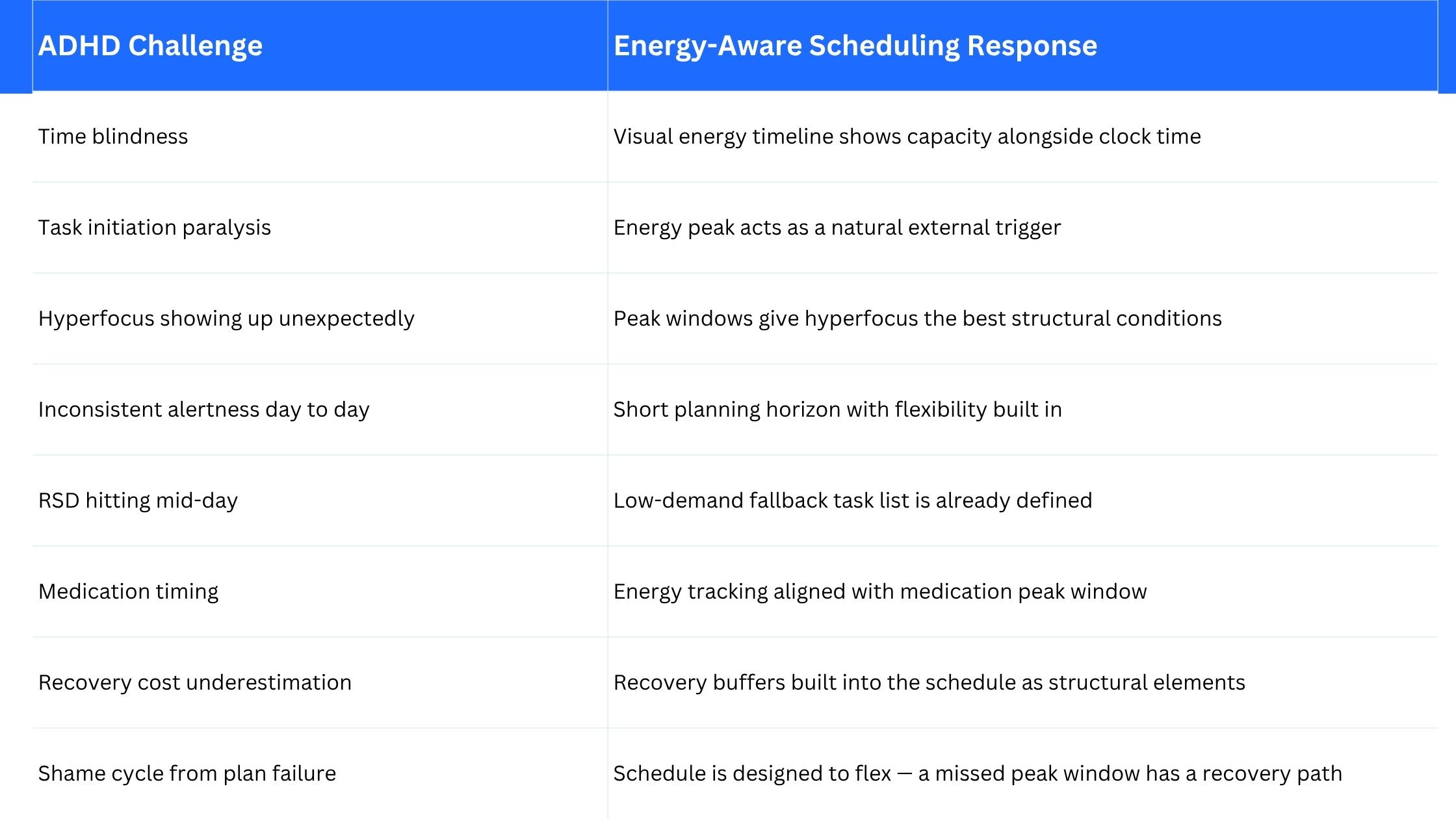
ADHD Challenges and Energy-Aware Responses
Where Tools Help
rivva is an AI daily planner that connects to wearables — Apple Watch, Fitbit, Oura, Whoop — and uses sleep and recovery data to build an Energy Timeline showing your cognitive peaks and dips throughout the day. Its AI assistant Nia schedules tasks into your peak windows automatically and adjusts when plans change. It also syncs with Google Calendar, Outlook, and iCloud.
The practical value for ADHD is that it automates the energy-tracking and task-matching work that would otherwise require consistent manual effort — which is exactly the kind of sustained administrative task that ADHD makes difficult.
Tiimo is a visual daily planner designed specifically for neurodivergent users. It uses timers, icons, and color-coded visual schedules to make time feel more concrete.
Focusmate pairs you with another person for a body-doubling video session. For ADHD task initiation, having a witness can provide the external stimulation that makes starting possible.
Frequently Asked Questions
Do I need a wearable to do energy-aware scheduling?
No. A wearable gives you more accurate data. But the manual tracking approach described above works. Start there. If you find the patterns useful and want better data, a wearable adds precision.
What if my energy is too variable to find patterns?
What works better is a system that starts fresh each day with a very short planning horizon. The night before or morning of, categorize your tasks, estimate your state honestly, and build a small plan from there. What’s the one high-demand task I can attempt today?
How do I handle meetings I can’t control?
The goal isn’t a perfect energy-matched schedule — it’s a better one. Even protecting 60–90 minutes of a reliable peak window for your hardest work moves the needle significantly.
What about days when nothing works?
Activate your low-energy day fallback, do what you can, and treat that as the day’s success. A schedule that has a graceful failure mode is more useful than a rigorous one that has none.
Does energy-aware scheduling work if I don’t take medication?
Yes. Medication is one input that affects the energy equation, but it’s not required for this approach to work.
Bottom Line
Standard scheduling advice was not designed for ADHD brains. It assumes consistent energy, treats time blindness as laziness, and creates a reliable shame cycle when its rigid structures inevitably fail.
Energy-aware scheduling doesn’t fix ADHD. It doesn’t make the hard parts easy. What it does is give you a framework that starts from the truth — your energy fluctuates, it’s not always predictable, and the relationship between what you plan and what you’re capable of is real and worth accounting for.
Track your energy for a week. Build categories. Match hard work to your peaks. Have a fallback plan. Use tools that work with this instead of against it.
You don’t need to overhaul everything at once. Pick one piece of this and try it for two weeks. The goal isn’t a perfect schedule. It’s a schedule you can actually use.