
The Ultimate Annual Planning Guide For 2026 New Year Goals
A practical playbook for founders and professionals who want 2026 to actually be different

What This Guide Covers
Many year-end-reviews feel performative. You list your wins, acknowledge some losses, set ambitious goals for next year, but by March, you’ve fallen back to old habits.
This guide teaches you how to extract real insights from 2025 and build a plan for 2026 that you’ll actually execute.
Part 1 shows you how to audit your year honestly. You’ll learn frameworks to identify what actually moved the needle versus what just felt productive.
Part 2 walks through goal-setting frameworks that work. Systems, anti-goals, quarterly themes, and accountability mechanisms.
Part 3 covers execution. How to start January right and maintain momentum.
Read this first. Then use the free companion template to do the actual work.
Intro
You’re exhausted. You worked incredibly hard this year. Your todo list is still overwhelming. Other professionals are posting their “year in review” threads with impressive metrics, and you’re wondering if you’re behind.
You’re told to celebrate wins, but that feels hollow when you know how much you didn’t accomplish. You’re told to set big goals, but you’ve tried that before and watched them fall to the wayside by February.
Most year-end reviews focus on outcomes you can’t change instead of patterns you can learn from. Or goal-setting focuses on what you want without considering the systems required to get there.
This guide takes a different approach. You’ll spend more time understanding why things happened and designing systems. The work is harder, but the results actually stick.
PART 1: HOW TO ACTUALLY LEARN FROM 2025
Activities vs Progress
You worked hard this year. Late nights, weekends, constant email. But hard work and meaningful progress aren’t the same thing.
Activities create motion. Responding to every email, attending every meeting, checking things off your list. It feels productive in the moment.
But progress is leverage. The work that actually moved your business forward, built your career capital, or improved your life. It compounds over time.
The gap between the two is where most people lose their year.
You need to separate the work that mattered from the work that just kept you busy. This requires honest assessment of where your time actually went and what it produced.
The Impact vs. Effort Matrix
Plot your major projects and activities from 2025 on this matrix:
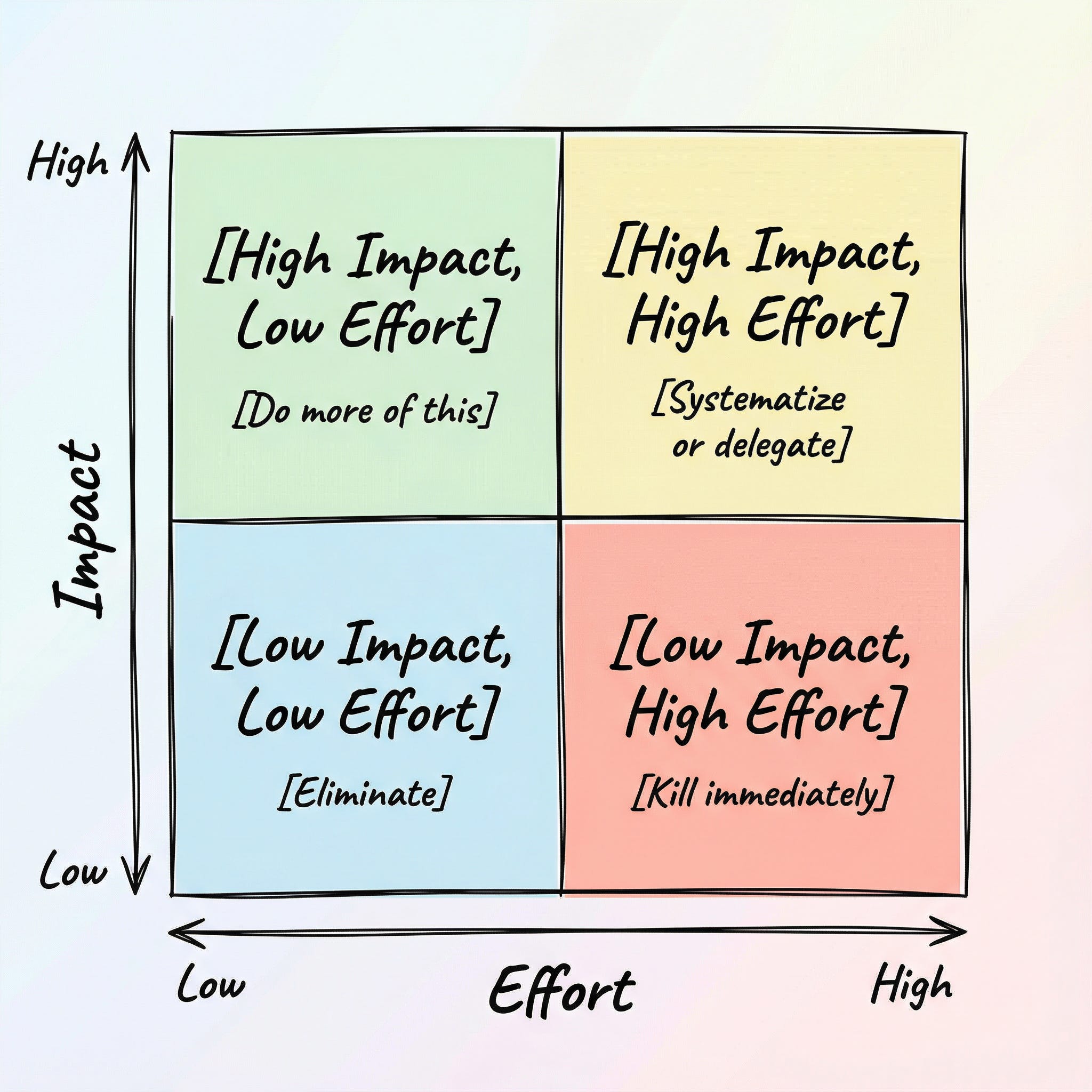
High Impact, Low Effort (Top-Left): Your gold mine. These are your leverage points. The question is whether you’re protecting enough time for them.
High Impact, High Effort (Top-Right): You can’t eliminate these entirely, but you can often systematize them, delegate parts, or batch them to reduce the cognitive load.
Low Impact, Low Effort (Bottom-Left): Usually harmless. These are fine if they energize you, but be honest about opportunity cost.
Low Impact, High Effort (Bottom-Right): Most people spend too much time here. Projects that consume enormous energy but barely move the needle. These are often the things that feel urgent or important but don’t actually create results.
Action item: List your top 10-15 work activities from 2025. Plot each one on this matrix. Look for patterns.
The 80/20 Analysis
The Pareto Principle states that roughly 80% of your results come from 20% of your efforts. This shows up everywhere.
20% of your clients probably generate 80% of your revenue. 20% of your features drive 80% of user engagement. 20% of your relationships provide 80% of the value.
But most people spend a lot of time on the 80% that barely matters.
Questions to ask:
What 20% of your work activities drove 80% of your business results?
What 20% of your relationships provided 80% of the support, joy, or opportunities?
What 20% of your learning/content consumed actually changed your thinking or behavior?
What 20% of your time produced 80% of your satisfaction or energy?
Be specific. Don’t just say “client work” drove results. Which clients? Which type of work? What made it high-leverage?
The brutal follow-up: What’s the 80% of work you’re doing that contributed minimally to your outcomes? Why are you still doing it?
Most people can’t eliminate all low-leverage work immediately. You have obligations, dependencies, and constraints. But you can start shifting the ratio. Small moves compound.
Action item: Identify your 20% in each category. Then identify at least three things from the 80% you can eliminate or reduce in 2026.
Doing Honest Autopsies
An autopsy is a detailed examination to determine what happened and why. Most year-end reviews skip the “why” part. They list outcomes without examining the root causes.
A. Decision Audit
Your year is the sum of your decisions. Big ones and small ones. Understanding your decision quality reveals your thinking patterns.
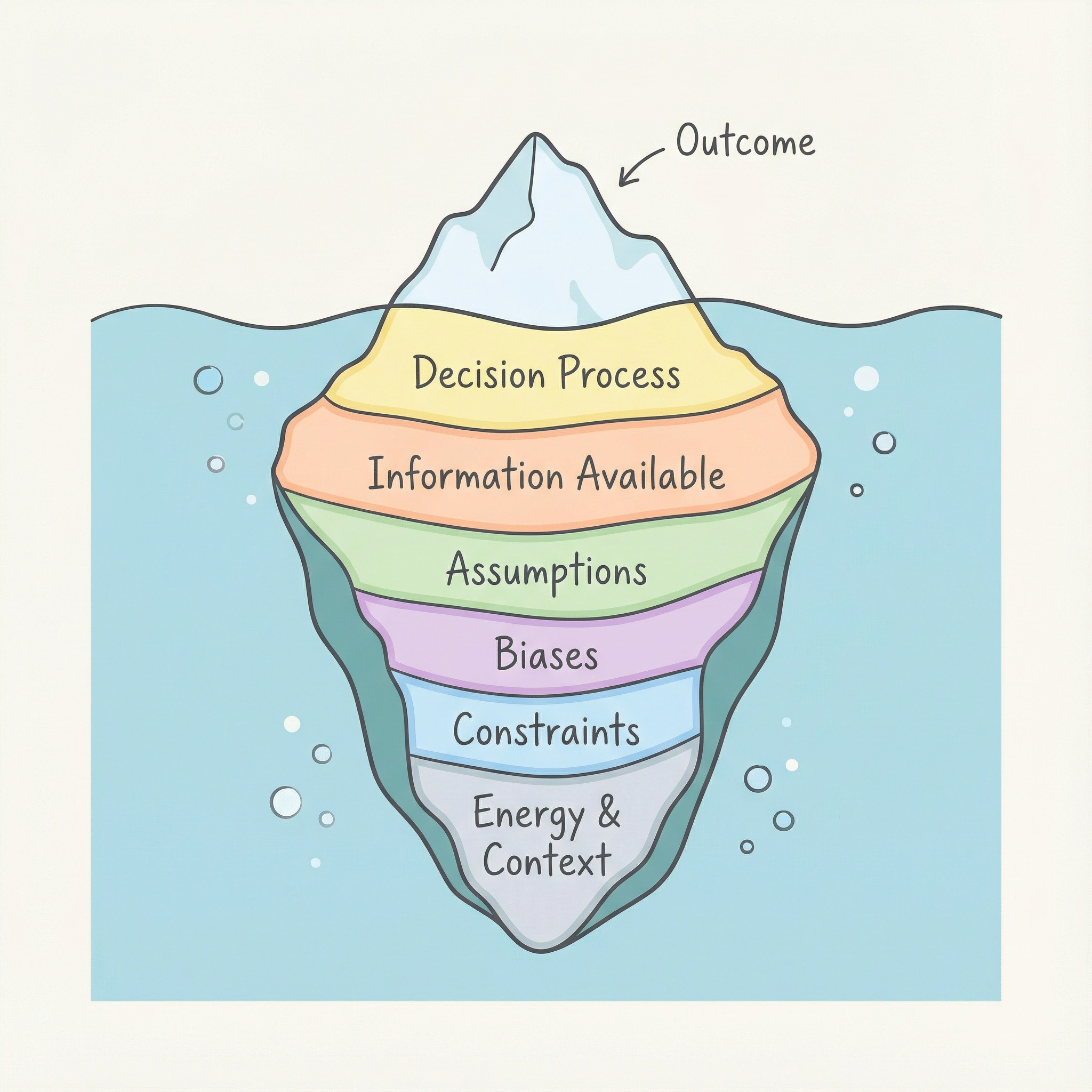
Most people focus only on outcomes. They beat themselves up over bad results even when the process was sound. They reinforce bad processes that happened to work out.
Separate the two. You can only control your process, not outcomes. Good processes over time produce good outcomes on average.
Pick your 3-5 most important decisions from 2025. These could be hiring, firing, product pivots, partnerships, saying no to opportunities, personal life changes.
For each decision, ask:
What information did I have at the time?
What was my decision-making process? Did I gather input? Sleep on it? Act impulsively?
What biases might have influenced me? (Optimism? Sunk cost? Peer pressure? FOMO?)
Knowing what I know now, would I make the same decision?
What would have made this decision better?
The decisions you avoided matter too. What did you put off or refuse to confront? Firing someone who wasn’t working out? Having a hard conversation? Shutting down a failing project? Leaving a relationship?
Use the Regret Minimization Framework (the 10-10-10 rule): Will you regret this decision in 10 minutes? 10 months? 10 years?
Action item: Complete the decision audit for your top 5 decisions. Identify patterns in how you make good vs. bad decisions.
Relationship Quadrant
Your relationships shape your outcomes more than you want to admit. Who you spend time with influences your thinking, your opportunities, and your energy.
Most people are too generous in evaluating relationships. They keep investing in people out of obligation, history, or guilt rather than actual value exchange.
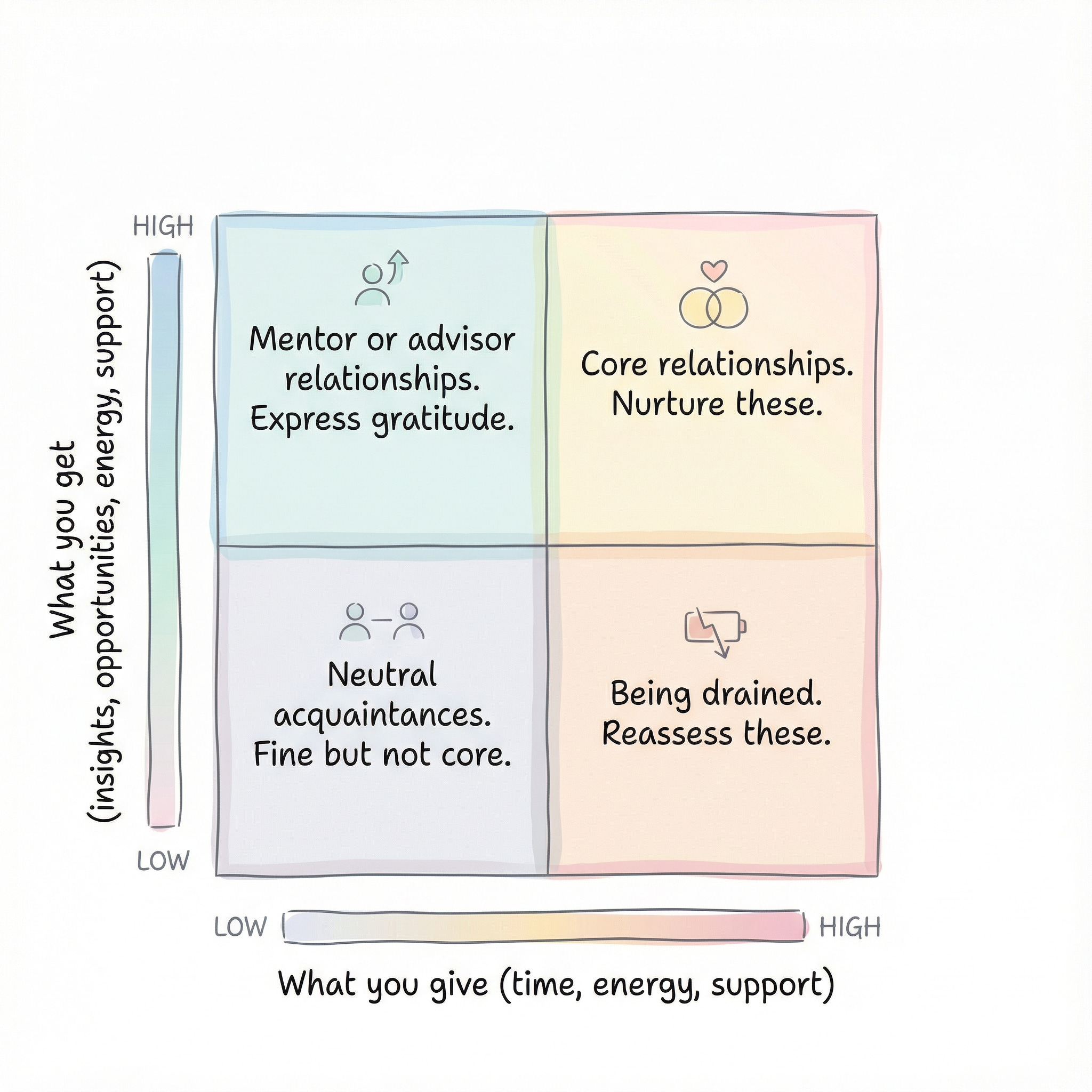
The hard truth is that some relationships in the “high give, low get” quadrant need to end or dramatically shift. You’re being drained.
This doesn’t make the other person bad. It means the relationship isn’t serving you both well.
Questions to ask about each key relationship:
Does this person help me grow or keep me stuck?
Do I feel energized or drained after spending time with them?
Do I associate them with positive emotions (joy, fulfillment, trust, support)?
Would I choose to build this relationship today if I didn’t have the history?
Action item: Map your top 10-15 relationships on this quadrant. Identify 2-3 relationships to invest more in and 2-3 to reduce or end.
System Autopsy
You probably tried productivity systems this year. Some stuck. Most didn’t. Each failure is a lesson about what works for you versus what sounds good in theory.
Friction Analysis:
For each system you attempted (and abandoned), ask:
What was the intended behavior?
What friction prevented it? Too many steps? Didn’t integrate with existing tools? Required too much thinking?
What would have made it easier?
What does this tell me about how I actually work?
Common friction points:
Too complex: Required remembering too many steps or rules
Not integrated: Lived in a separate tool you forgot to check
Manual overhead: Required constant updating or maintenance
Didn’t match reality: Designed for your ideal self, not your actual self
No immediate reward: Benefits were too far in the future
Pattern recognition: What keeps breaking? If you’ve tried three different task managers with similar approaches yet abandoned all of them, the problem isn’t the tool. It’s probably that you don’t work well with task managers.
The goal isn’t to find the perfect system. The goal is to understand your constraints and design around them.
The Minimum Viable System Test: What’s the simplest version that would actually work? Strip away everything optional. What’s left?
Often the system that works is embarrassingly simple. Simple systems have less friction. Less friction means higher adherence.
Action item: List every productivity system you tried in 2025. Do the friction analysis. Identify what your failures are teaching you about how you actually work.
What Your Failed Systems Are Telling You
This deserves its own section because it’s where most people give up.
You’ve probably blamed yourself. “I’m not disciplined enough.” “I can’t stick to anything.” “I’m just disorganized.”
Wrong framing. Your failed systems are data about what doesn’t work for you. That’s valuable information.
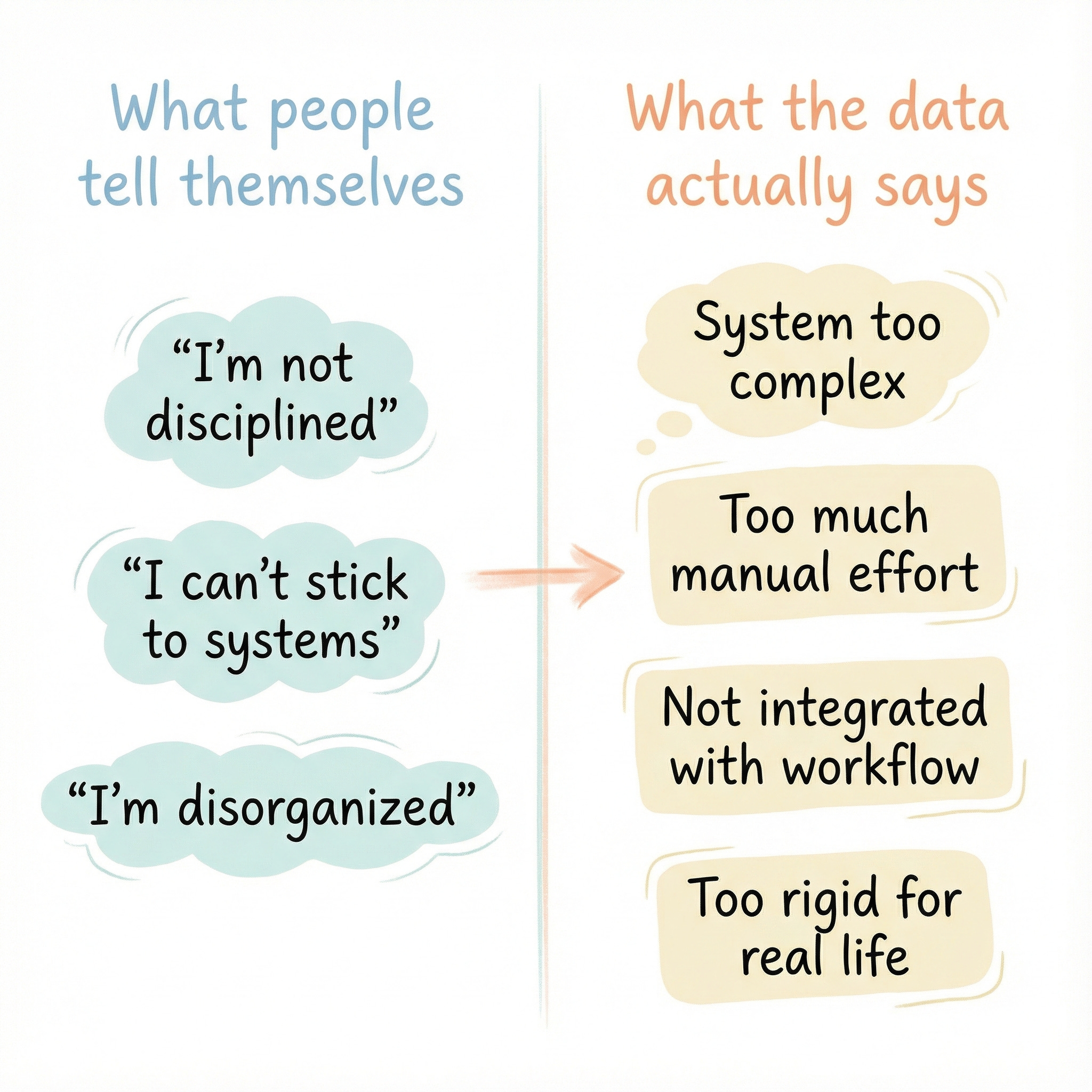
Key insights from failed systems:
If you abandoned complex systems: You need simplicity. Your system should be obvious and require minimal decisions. Three priorities for the day. One outcome for the week. That’s it.
If you abandoned manual tracking systems: You need automation. If it requires you to remember to update something, it will fail. You need tools that capture data passively or systems that are baked into your workflow.
If you abandoned systems in separate tools: You need integration. Your system should live where you already work. If you use email and calendar heavily, your system needs to integrate there.
If you abandoned rigid systems: You need flexibility. Life is chaotic. Your system needs to accommodate bad days, unexpected fires, and changing priorities. If it breaks when you miss a day, it’s too brittle.
If you abandoned all systems: You might not need one. Some people work best in structured chaos. They keep everything in their head and it works. If your outcomes are good, don’t force yourself into someone else’s system.
The point is to stop judging yourself and start observing yourself. You have patterns. Design around them instead of fighting them.
Action item: Based on your system autopsy, write down 3-5 principles for any system you build in 2026. Example: “Must integrate with email,” “No manual tracking,” “Maximum 5 minutes of daily overhead.”
PART 2: HOW TO ACTUALLY PLAN 2026
Common Goal-Setting Mistakes
Before we get into frameworks that work, let’s cover what doesn’t work and why.
Goals are too vague. “Grow the business” isn’t a goal. “Increase revenue” isn’t a goal. These give you nothing actionable. You can’t measure progress. You can’t know if you’re on track.
Pure outcome focus with no process. “Hit $500K revenue” is an outcome. What’s the system that gets you there? How many customers? What’s the conversion rate? How many leads do you need? What’s the weekly activity required?
Too many goals. Everything is a priority means nothing is a priority. You can’t focus on 10 goals simultaneously. Pick 3-5 maximum. Ruthlessly eliminate the rest or acknowledge they’re not really priorities.
Set in an optimistic state, executed in a normal state. You set goals when you’re motivated, rested, and excited about the future. You think you can achieve anything if you just set your mind to it. But you execute the goals when you’re tired, stressed, and dealing with real constraints.
That’s why goals need to be realistic for your normal state, not your peak state.
No built-in accountability. Who’s checking on your progress? How often? What happens if you’re off track?
Most goals fail here. The planning feels good. The execution quietly dies.
No plan for failure. You will fall off track. Something will go wrong. Life will happen. If you don’t have a plan for getting back on track, one slip becomes a spiral.
Keep these mistakes in mind as we walk through frameworks that address each one.
From Outcomes to Systems
This is the most important mindset shift in this entire guide.
Outcomes are what you want. Systems are how you get there.
Most people set outcome goals. “Launch new product.” “Hit $X revenue.” “Lose 20 pounds.” Then they hope for the best. But hope is not strategy
You need to translate every outcome into a system. A system is the repeatable process or behavior that produces the outcome over time.
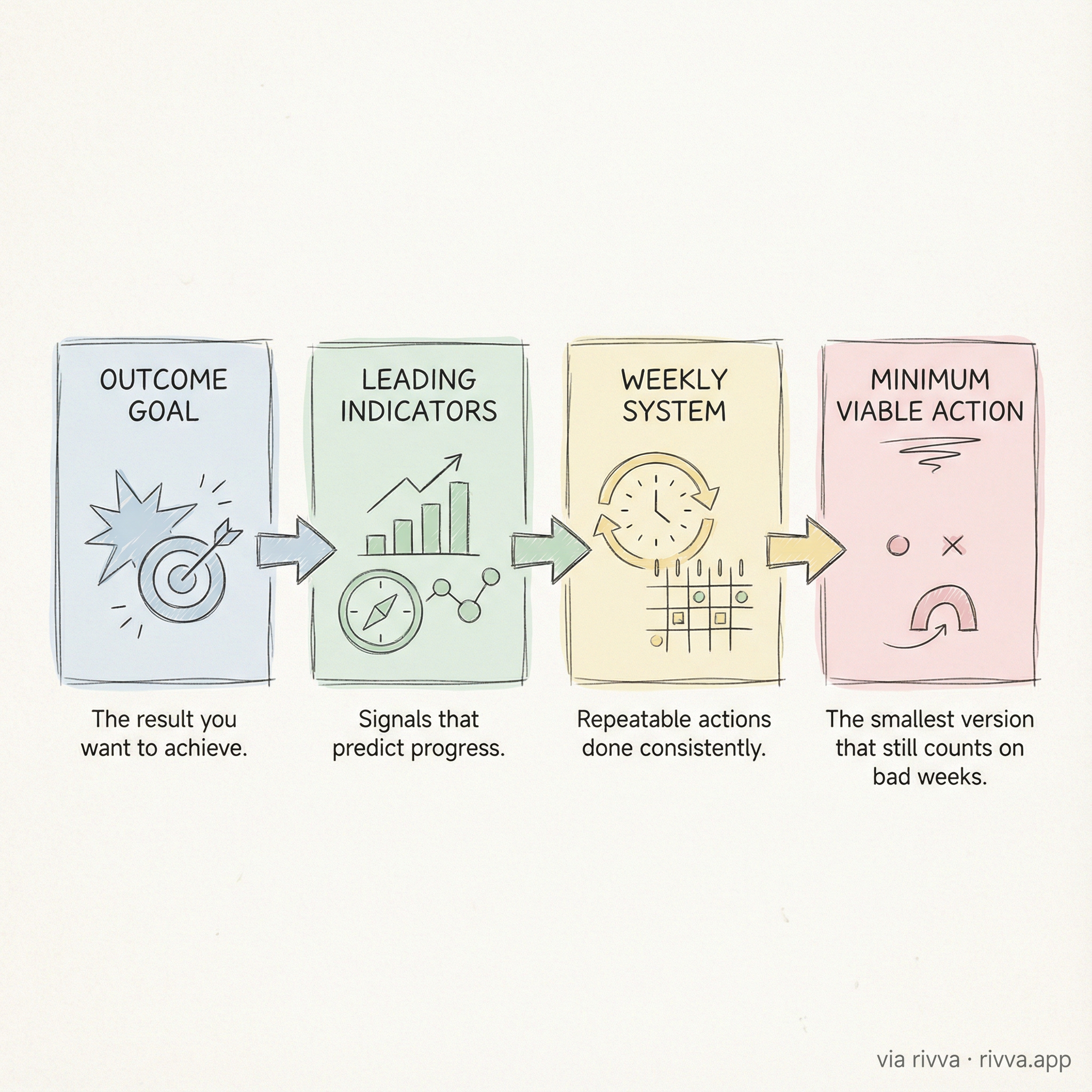
Outcome → System Translation:
Outcome Goal: Specific, measurable result you want
Leading Indicators: What metrics predict this outcome?
Weekly System: What do you do regularly to move those indicators?
Minimum Viable Action: Smallest version that still counts (for terrible weeks)
Example 1: Product Launch
Outcome: Launch new product by June
Leading Indicators: User interviews completed, prototype iterations, beta user signups
Weekly System: 5 user conversations, 1 iteration cycle, 1 marketing experiment
Minimum Action: Even in a terrible week, complete 2 user conversations
Example 2: Revenue Growth
Outcome: Grow from $20K to $50K MRR
Leading Indicators: Qualified leads, demo calls, conversion rate, churn rate
Weekly System: 20 outreach emails, 5 demo calls, 2 customer success check-ins
Minimum Action: Even in a terrible week, send 10 outreach emails
Example 3: Health
Outcome: Improve energy and reduce burnout
Leading Indicators: Sleep hours, exercise sessions, deep work blocks
Weekly System: 7+ hours sleep nightly, 3 gym sessions, 5 deep work blocks
Minimum Action: Even in a terrible week, get 6 hours sleep and 1 gym session
Notice the pattern. The outcome is directional. The system is specific and repeatable. The minimum action gives you a floor so you don’t spiral when life gets messy.
Why outcomes alone fail: They’re far in the future, you don’t know if you’re on track until it’s too late, they don’t tell you what to do tomorrow, and one setback feels like total failure.
Why systems work: They’re actionable today, trackable weekly, build habits that compound, and are forgiving.
For each major goal in 2026, don’t stop at the outcome. Build the system.
Action item: Translate your top 3-5 goals using this framework.
The Anti-Goal Method
Starting with what NOT to do is often more powerful than what TO do.
You have limited time, energy, and attention. Every yes to one thing is a no to something else.
Most people set goals by addition. “I want to do X, Y, and Z.” They don’t account for what they’ll stop doing to make room.
The Anti-Goal Setting Process:
Step 1: List everything you could potentially do or commit to in 2026. Be exhaustive. Include business opportunities, personal goals, relationships, and everything that sounds good or that others expect from you.
Step 2: For each item, ask: “If I do this, what don’t I get to do?”
Be specific. If you launch a second product, what doesn’t get the attention? Your core product? Your personal life? Your health?
Step 3: Mark the opportunities that sound good but would actually drain you. These go on your Not-To-Do List. Example of anti-goals
Step 4: Write your Not-To-Do List for 2026. Be specific. This is your filter for the year.
New opportunities will come up during the year that you didn’t include on your Not-To-Do list. In those cases, use a “Hell Yes or No” filter.
If it’s not a “hell yes,” it’s a hell no.
This sounds extreme, but it’s necessary. You’re constantly bombarded with opportunities that sound interesting, might be valuable, and could lead somewhere. But most of them are distractions.
You need a high bar. If you’re not genuinely excited and it doesn’t clearly align with your top priorities, decline it.
Action item: Create your Not-To-Do List for 2026. Identify at least 5-10 specific things you’re committing to NOT doing.
SMART Goals
You’ve probably heard of SMART goals. Here’s how to actually use them.
SMART Goal Structure:
Specific: Not “grow revenue” but “add $50K MRR from enterprise customers.”
Be precise. Who’s the target customer? What’s the exact metric? What counts as success?
Vague goals give you permission to not really try. Specific goals hold you accountable.
Measurable: Exact metric, tracked where and how often?
“Grow audience” isn’t measurable. “Grow email list from 500 to 2,000 subscribers, tracked in ConvertKit, reviewed weekly” is measurable.
You need a number and a tracking mechanism. If you can’t measure it weekly or monthly, you can’t manage it.
Achievable: Based on what evidence? What’s your track record?
This is where most people fail. They set goals based on what they want, not what’s realistic given their constraints and past performance.
If you’ve never closed an enterprise deal, aiming for $50K MRR from enterprise in Q1 is probably unrealistic. You need to build the skill, the pipeline, the process.
Achievable doesn’t mean easy. It means grounded in reality. Look at your past data. What was your growth rate last year? What’s a reasonable acceleration? What’s the benchmark for others in your industry?
Relevant: Does this goal actually matter? Is it core to your strategy or a distraction?
Many goals sound good in isolation but don’t ladder up to what you’re building. Be ruthless here. If it doesn’t directly contribute to where you’re trying to go, cut it.
Time-bound: By when? With monthly milestones?
“By end of year” is too far away. You need monthly milestones so you can course-correct.
Example: “Grow email list to 2,000 subscribers by Dec 31”
End of Q1: 800 subscribers
End of Q2: 1,200 subscribers
End of Q3: 1,600 subscribers
End of Q4: 2,000 subscribers
Now you can check progress monthly. If you’re at 600 by end of Q1, you know you’re off track and need to adjust your system.
Action item: For each goal, complete the SMART framework fully
Quarterly Themes Over Annual Goals
12-month planning is mostly fantasy. Too many things will change. You can’t predict what will happen in Q3 when you’re planning in January.
The solution: quarterly themes with 90-day sprints.
Why quarterly works:
Short enough to maintain focus
Long enough to make real progress
Forces regular review and adjustment
Accounts for changing circumstances
Prevents year-long commitment to things that aren’t working
The Quarterly Theme Approach:
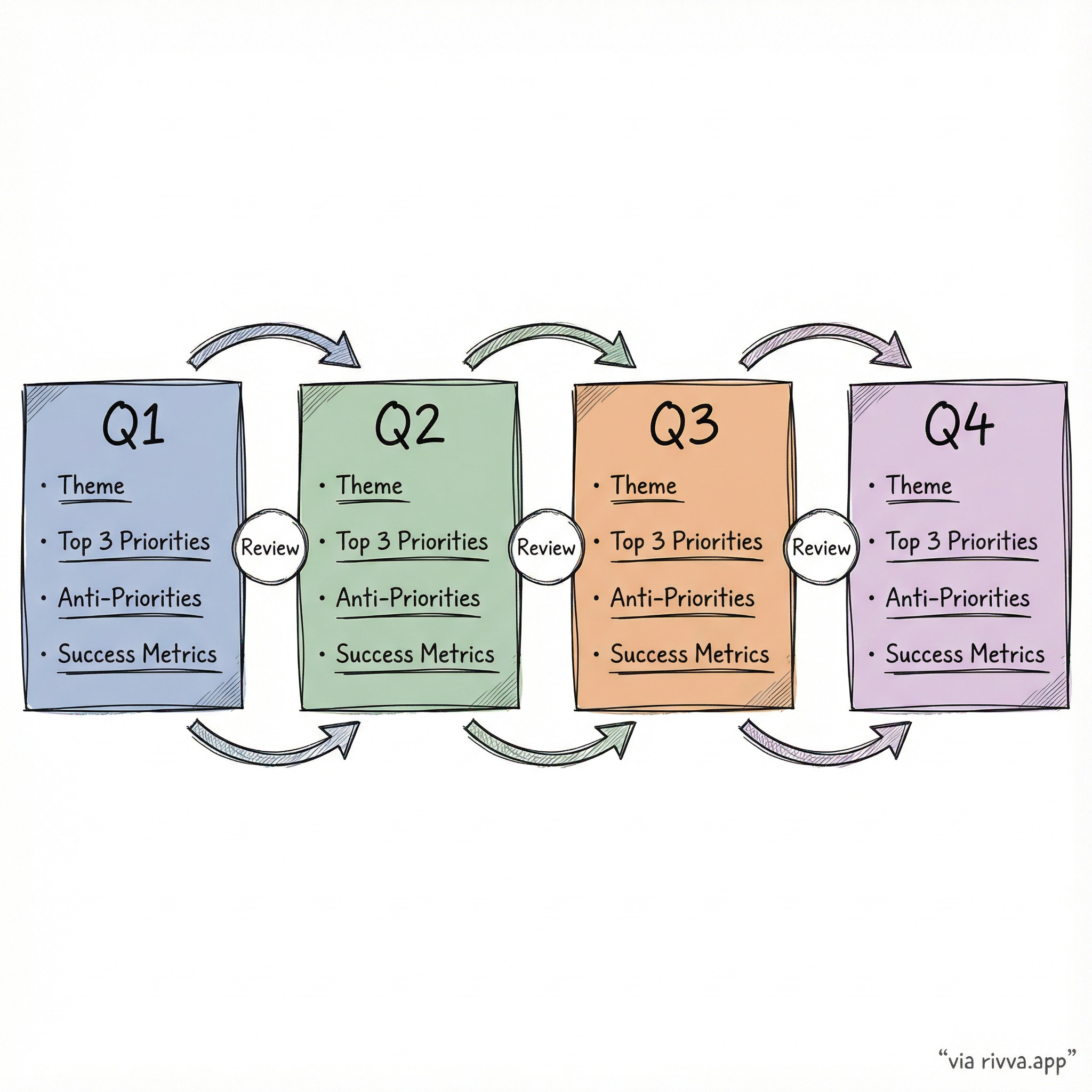
For each quarter, define:
1. Theme: One word or short phrase that captures the focus.
Examples:
Q1: Foundation (building core systems)
Q2: Growth (scaling what works)
Q3: Optimization (improving efficiency)
Q4: Expansion (new markets or products)
The theme gives you a decision filter. Does this opportunity fit Q1’s theme of Foundation? No? Then it waits or gets cut.
2. Top 3 Priorities: What must happen this quarter?
Not 5 or 10. Three. These are your non-negotiables. Everything else is secondary.
3. Anti-Priorities: What you’re explicitly NOT doing this quarter.
This is critical. You’re giving yourself permission to ignore certain things. They might be important eventually, but not right now.
Example: “In Q1, we are NOT working on marketing, NOT adding new features, NOT hiring.”
This prevents scope creep and protects your focus.
4. Success Metrics: What does “good” look like on March 31 (or June 30, Sept 30, Dec 31)?
Specific numbers. How will you know if this quarter was successful?
Example for Q1:
20 beta users actively using product
15 user interviews completed
Product roadmap defined for Q2
5. Review Date: When you’ll assess and plan the next quarter.
Put this on your calendar now. Last week of the quarter. Non-negotiable.
How to build connected quarters:
Your quarters should build on each other. Q1 enables Q2. Q2 enables Q3.
Example progression:
Q1: Build MVP and validate with 20 beta users
Q2: Iterate based on feedback and launch to 100 early customers
Q3: Build marketing engine and grow to 1000 customers
Q4: Raise $600K pre-seed
Notice how each quarter depends on the previous one succeeding. This forces you to be realistic about pacing.
The quarterly review process:
End of each quarter, ask:
Did we hit our top 3 priorities? If not, why?
What worked that we should do more of?
What didn’t work that we should stop?
What did we learn that changes our assumptions?
What’s the theme and priorities for next quarter?
This review takes 2-3 hours. Block it on your calendar for the last week of March, June, September, and December.
Action item: Define your Q1 theme, top 3 priorities, anti-priorities, and success metrics. Sketch out themes for Q2-Q4 (knowing they’ll likely change).
Monthly Check-Ins
Weekly is for execution. Quarterly is for strategy. Monthly is for course-correction.
You need a middle layer between the tactical (weekly) and strategic (quarterly). Monthly check-ins give you that.
The Monthly Review (30 minutes, first Monday of each month):
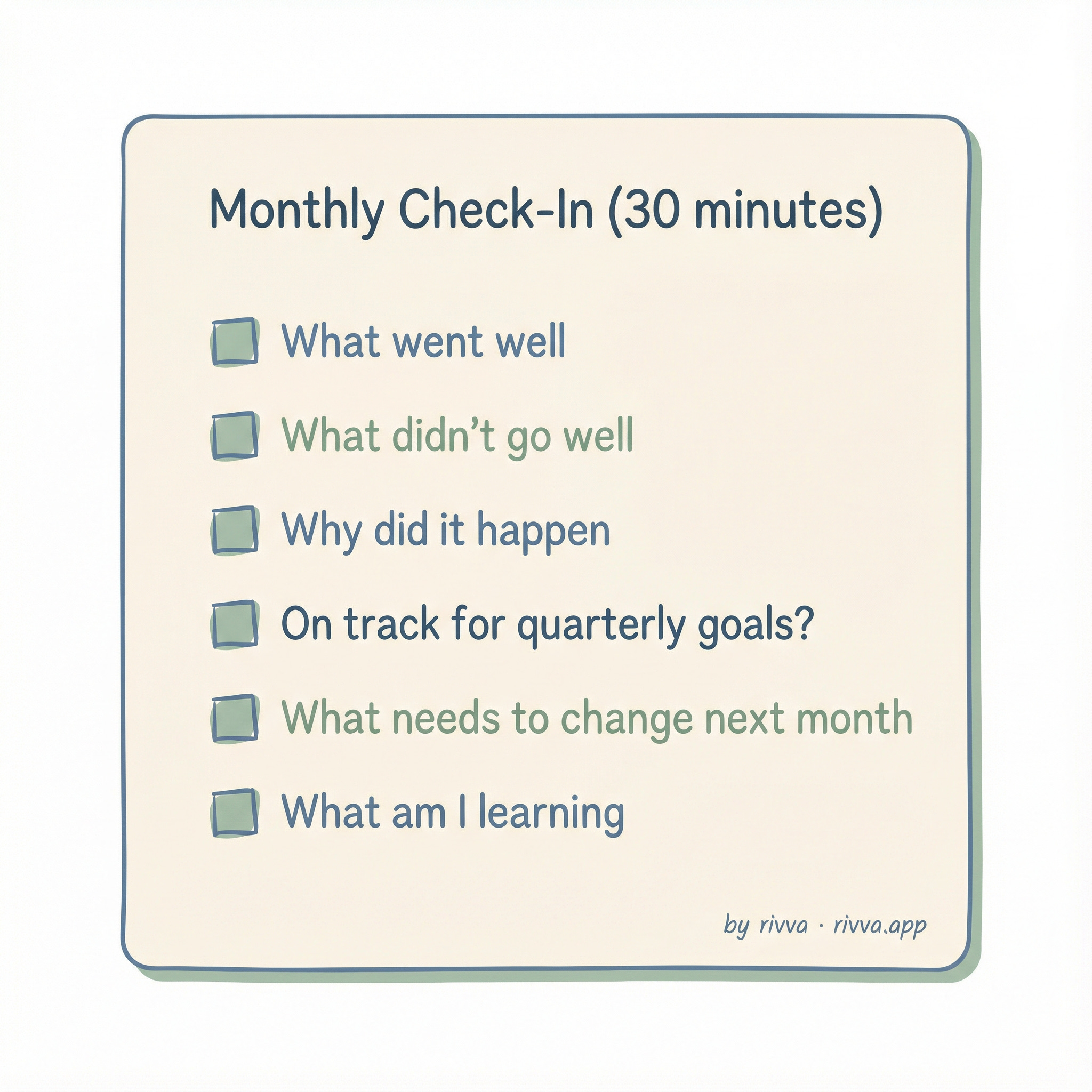
1. What went well this month?
List 3-5 wins. Celebrate them. This isn’t frivolous. Acknowledging progress maintains motivation.
2. What didn’t go well?
List 3-5 things that went wrong or fell short. No judgment. Just observation.
3. Why did those things happen?
This is where the learning is. Don’t just list problems. Diagnose root causes. E.g.
“Didn’t hit outreach goal because I deprioritized it when client work got busy”
“Missed gym sessions because I was too exhausted from work”
“Product launch delayed because we underestimated technical complexity”
4. Am I on track for quarterly goals?
If behind, either adjust your system, adjust your timeline, or add resources. Don’t wait until end of quarter to realize you’re off track.
5. What needs to change next month?
Examples:
“Block 30mins outreach time on calendar before client work”
“Move gym sessions to morning instead of evening”
“Bring in contractor to handle technical work”
Small adjustments compound. You don’t need to overhaul everything. You need to fix one thing.
6. What am I learning?
What are these patterns teaching you about how you work, what you need, or what actually matters? This is how you improve your self-knowledge over time.
Action item: Set up recurring monthly review time on your calendar for the entire year. First Monday of each month, 30 minutes, non-negotiable.
Personal OKRs
OKRs (Objectives and Key Results) are common in companies, but they work for individuals too.
The Structure:
Objective: Qualitative goal. Inspiring and directional. Answers “What do I want to achieve?”
Key Results: 3-5 quantitative measures of success. Answers “How will I know I achieved it?”
Initiatives: The projects or work that drive the key results. Answers “What will I actually do?”
Example:
Objective: Become a recognized expert in [your field]
Key Results:
Publish 12 pieces of original content (blog posts, articles, guides)
Speak at 3 industry events or podcasts
Grow engaged audience to 5,000 (email, Twitter, LinkedIn combined)
Initiatives:
Weekly writing habit (Sunday mornings, 2 hours)
Submit to 10 conference CFPs in Q1
Daily posting on Twitter
How to review OKRs:
Weekly: Are initiatives on track? Am I doing the work?
Monthly: Are key results moving in the right direction? If not, why? Do I need to adjust initiatives?
Quarterly: Did I achieve the objective? What worked? What didn’t? What’s next?
OKRs give you clarity on what matters and how to measure it. They connect the big picture (objective) to the daily work (initiatives).
Action item: Set 2-4 OKRs for 2026.
Planning for Reality
Most goal-setting happens in an optimistic state. You’re energized, motivated, and excited about what’s possible. This is when you overcommit.
Then reality hits. You’re tired. Client work piles up. Life happens. The goals you set in January feel impossible by March.
The solution: plan for your normal state, not your peak state.
Realistic Capacity Audit
Here’s how to find your actual available hours per week. Let’s start with the basics. You have 168 hours per week (24 hours × 7 days).
Subtract non-negotiables, e.g.
Sleep: 7-8 hours × 7 days = 49-56 hours gone
Family time: School drop-offs, homework help, meal prep
Existing commitments: Client work, meetings, existing obligations
Subtract reactive work, e.g.:
Email: How many hours per week?
Meetings: How many hours per week?
Fires and urgent issues: How often do you have to jump on a quick call or switch to an urgent task?
Subtract buffer for life:
Add some buffer time for rest and recovery. You could get a headache. You could get meeting fatigue. Unexpected things are likely to happen.
What’s left = Your realistic discretionary hours.
This is the time available for working on personal goals. For most people, it’s far less than they think.
If you have 10 discretionary hours per week, and your goals would require 20 hours per week, the math doesn’t work. Something has to give.
Look at your goals. Add up the time required. Compare it to your discretionary hours. If there’s a mismatch, you have three options:
Reduce your goals
Eliminate something to free up time
Accept that progress will be slower than you’d like
If you skip this step, you might set goals that require time you don’t have.
Beyond Time: Understanding Your Capacity
But here’s what the time audit misses: not all hours are equal.
Your brain doesn’t maintain consistent output throughout the day. Your energy fluctuates. Your focus ebbs and flows. After six meetings, you’re fried. After a bad night’s sleep, deep work feels impossible.
Yet most planning systems ignore this completely. They treat all hours as equal. Schedule the hardest work whenever there’s an opening. Push through when you’re tired.
This is why you end days feeling busy but not productive. Why you’re exhausted but your important work barely moved forward.
Questions to ask when planning your week:
When am I naturally sharpest? (Protect this for deep work)
What time of day do I crash? (Don’t schedule strategic thinking here)
How many meetings can I handle before I’m useless? (Batch or space them accordingly)
What’s my capacity after a bad night’s sleep? (Have a minimum viable plan)
When do I need buffer time to recharge? (Build it in, don’t hope for it)
Look at your calendar for next week. Identify your peak energy periods—usually mornings for most people, but you know yourself best.
Block those times for your most important work. The strategic thinking. The creative problem-solving. The deep focus tasks that actually move your goals forward.
Then schedule meetings, email, admin, and other lighter tasks for your lower-energy periods.
Tools like rivva take this even further—automatically scheduling your tasks based on your energy patterns, sleep data, and calendar, so deep work always lands when you can actually do it well. But even without tools, you can start applying this principle manually today.
Action item: Complete the capacity audit. Calculate your realistic discretionary hours. Check if your goals fit.
Planning For Failure
You will fall off track. Something will go wrong. Life will happen. This isn’t a character flaw. It’s reality.
The problem isn’t the failure. The problem is having no plan for recovery. One missed week turns into two. Two turns into a month. By March, you’ve quietly given up.
The Pre-Mortem Exercise:
Assume it’s December 2026. Your goal failed. Why do you think it happened
Brainstorm 5-10 reasons, e.g.
Got too busy with client work and deprioritized the goal
Lost motivation after the initial excitement wore off
Hit an unexpected obstacle and didn’t know how to proceed
Didn’t have accountability and quietly let it slide
Life event (illness, family crisis, job change) derailed everything
The goal was unrealistic given actual time/energy constraints
For each reason, create an If-Then plan:
If [obstacle happens], then I will [specific backup action].
This removes decision-making in the moment when motivation is low. You’ve already decided what to do.
Examples:
If I can’t make it to the gym, then I’ll do 20 push-ups at home and a 10-minute walk
If I’ve had three bad nights of sleep, then I’ll take a rest day instead of forcing it
If I’m too tired to plan on Sunday night, then I’ll start Monday 30 minutes early to do it
If the week goes completely off track, then I’ll reset on Wednesday with my top 3 priorities
If I don’t know what to write about, then I’ll write about what I learned this week
If I’m feeling burnt out, then I’ll repurpose an old piece instead of creating something new
Notice the pattern: You’re not planning to be perfect. You’re planning for what to do when things go wrong.
Action item: For your top 3 goals, write 3-5 If-Then statements that cover the most likely obstacles.
Accountability Systems
Willpower fails. Systems work. If you rely on motivation and discipline alone, you’ll fall off within a couple months.
You need external structure. Accountability comes in three layers.
The Three-Layer Accountability System:
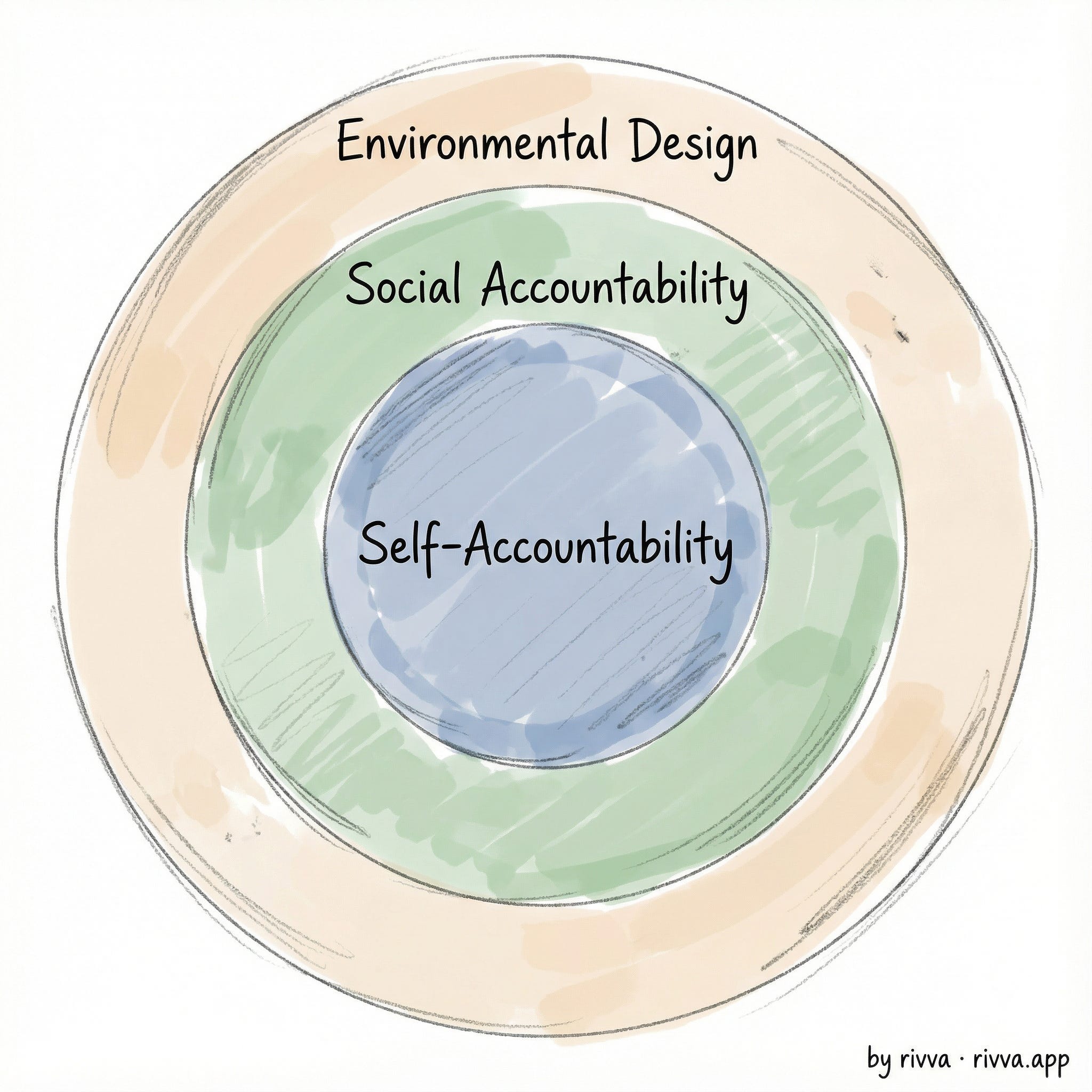
Layer 1: Self-Accountability
This is you holding yourself accountable through tracking and review. E.g. weekly reviews, monthly metric checks, quarterly deep reviews
Layer 2: Social Accountability
This is other people holding you accountable. There are various ways to do this.
Accountability partner: Find someone with similar goals. Have regular check-in calls to share weekly commitments and report on previous week progress.
Public commitment: When people know what you’re working on, you’re more likely to follow through.
You can post your goals on social media and give weekly or monthly updates (e.g. #buildinpublic)
Community: Join a mastermind or community of people like you. The group can provide support and pressure with regular check-ins or progress updates.
Stakes: Put money on the line. This provides real consequences for not following through, but it only works if you’re loss-averse.
Layer 3: Environmental Design
This is designing your environment so good behavior is the default. You do this by making good behaviour easy and bad behaviour hard.
You can make good behaviour easy by prepping healthy food in advance, blocking out deep work time on your calendar, etc.
You can make bad behaviour hard by locking distracting apps during work hours, putting the TV remote in another room, etc.
You can also set up recurring default behaviours. If your goal is to save, set up automatic savings transfers. If your goal is deep work, set up recurring calendar blocks. Set up standing meetings with your accountability partner or pre-scheduled weekly review times
How to choose your mix:
Not everyone needs all three layers. Some people do great with just self-accountability. Others need the social pressure. Many need environmental design because willpower isn’t enough.
Try multiple approaches. See what sticks. Double down on what works.
The key is having something. No accountability means goals quietly die
Action item: For each major goal, define your accountability system. Which layers will you use? Be specific about what, when, and with whom.
PART 3: DOING THE WORK
Starting Right Now
Whenever you’re reading this, start right now. The best time to start was yesterday. The second-best time is right now.
Don’t wait for the beginning of a new week or new month or new quarter.
Start this week:
Complete the year-end review using the companion template
Choose your top 3 goals for 2026
Build the system for each goal: Translate outcomes into weekly actions using the framework from Part 2.
Set up your tracking
Block time on your calendar: Recurring blocks for your priorities. Treat them like meetings you can’t miss.
Create your If-Then plans: What will you do when things go wrong?
Start small:
You don’t need to transform your entire life overnight. Start with one goal. One system. One weekly commitment.
Execute on that for 2-4 weeks. Once it’s stable, add the next one.
This is how sustainable change happens. Not through massive overhauls that collapse by February, but through small, consistent additions that compound over time.
Action item: Block 2 hours this week to complete your year-end review and Q1 planning. Put it on your calendar right now.
Weekly Planning
This is the most important habit you’ll build. Weekly planning and review keeps you on track.
Most people plan at the beginning of the year and drift by March. Weekly reviews prevent that.
The Weekly Planning Ritual:
When: Sunday night or Monday morning. Pick one and make it consistent.
How long: 10-15 minutes
The Structure:
1. Review last week (3 minutes):
What were my top 3 priorities?
Did I complete them? (Yes/No for each)
If no, why not?
What worked well? What didn’t work?
2. Plan this week (5 minutes):
What are my top 3 priorities this week?
When will I work on each? (Block time on calendar)
What’s my minimum viable week? (If everything goes wrong, what still has to happen?)
3. Anticipate obstacles (2 minutes):
What could derail me this week?
How will I prevent it?
If it happens anyway, what’s my backup plan?
What if you miss a week?
You will. Don’t spiral. Just do the next one.
Missing one week isn’t failure. Quitting because you missed one week is failure.
Action item: Choose your weekly planning time. Put it on your calendar as a recurring event for the entire year.
CONCLUSION
The difference between people who achieve their goals and people who don’t isn’t intelligence. It isn’t talent. It isn’t even having better goals.
The difference is two things:
Honest self-knowledge
Understanding how you actually work, not how you wish you worked. Designing systems around your real constraints, not your ideal self. Learning from your failures instead of repeating them.
Consistent execution
Showing up weekly. Tracking progress. Course-correcting quickly. Not quitting when you miss a week or hit an obstacle.
You’ve learned frameworks. You have structures. You know what to do.
The question is whether you’ll actually do it.
To recap, here’s what needs to happen:
Today:
Complete the companion template
Set up your tracking system
Block your weekly review times on calendar
First week of January:
Define your Q1 theme and top 3 priorities
Create If-Then plans for likely obstacles
Protect your peak energy hours for deep work
Every week of 2026:
Do your weekly planning and review
Track your metrics
Every month:
Complete your monthly review
Course-correct as needed
Celebrate progress
Every quarter:
Deep review and planning session
Adjust strategy based on what you’ve learned
This isn’t complicated. It’s just consistent.
Most people overestimate what they can do in a week and underestimate what they can do in a year with consistency.
Small actions compound. Weekly reviews compound. System improvements compound.
In 12 months, you’ll either be someone who talks about goals or someone who achieves them.
The choice is yours.
Ready to do the work?
Get the free companion template:
The template walks you through each framework in this guide with fill-in-the-blank exercises. It’s where you do the actual planning.
Want your planning to actually stick?
The hardest part isn’t making the plan. It’s executing it consistently when life gets chaotic.
That’s where rivva helps. rivva is an intelligent workspace that automatically captures your commitments, understands your capacity patterns, and schedules work when you can actually do it well—not just when you’re available.
Think of it as having a personal assistant who knows your energy rhythms, protects your focus time, and adjusts your plan when meetings run long or priorities shift. So you can spend less time managing your day and more time executing on what matters.
Join the waitlist: rivva.app
Good luck with 2026. Make it count.