
11 Best ADHD Productivity Apps for Fluctuating Energy
ADHD brains don't need more tasks. They need a system that understands fluctuating capacity, task paralysis, and the days when everything feels impossible.

Most productivity apps were built for people who wake up at the same energy level every day, can follow a rigid schedule, and just need a place to write their to-do list. That is not an ADHD brain.
When you have ADHD, the problem is rarely that you don’t know what needs to get done. The problem is that your energy, focus, and executive function are unpredictable. The right tool does not demand that you perform consistency you don’t have.
What makes a productivity app actually work for ADHD?
1. Reduces decisions, not adds them — Decision fatigue hits ADHD brains hard. The best ADHD tools make decisions for you.
2. Makes time feel visible and concrete — Apps that show your day as a visual timeline give your brain something to actually work with.
3. Is energy-aware, not just schedule-aware — A meeting at 9am and a creative deep-work block at 9am are not the same thing.
4. Adapts to reality when the plan falls apart — Adaptive tools help you recover and rebuild, without the guilt spiral.
5. Has low setup and low friction to re-enter — Easy to return to after a few days away.
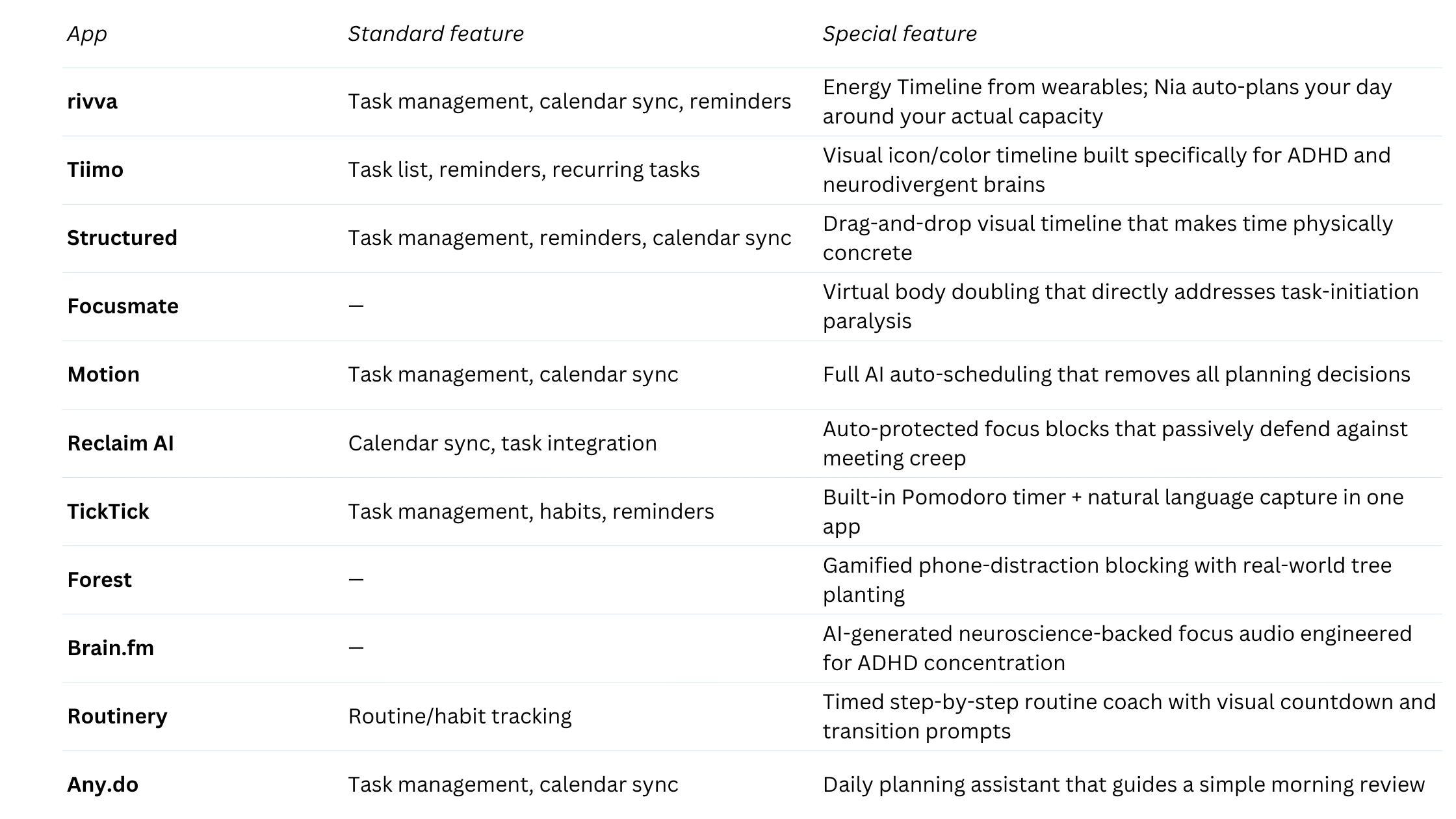
Quick comparison table:
The 11 best ADHD productivity apps
1. rivva
rivva is an AI daily planner built specifically for brains that fluctuate. Where every other app asks you to manage your energy, rivva actually reads it — connecting to your wearables to pull sleep data and forecast your cognitive peaks and dips before your day begins.
Best for: ADHD adults who are tired of plans that assume every hour is equal and every day is the same.
Key ADHD-friendly features:
Energy Timeline forecasts cognitive peaks and dips from wearable sleep data
Nia AI assistant builds your day automatically — just tell her what you have
Smart Scheduling places tasks in windows that match your energy, not just your calendar
Voice input and time-blocking reduce the friction of actually starting
Pricing: $10/month or $80 per year. 7-day free trial. Available on iOS, Android, and web.
2. Tiimo
Tiimo is a visual daily planner designed from the ground up for ADHD and autistic adults who thrive with structure, color, and visual routines.
Best for: ADHD adults who are highly visual and struggle with text-heavy planners.
Pricing: ~$5/mo or ~$36/year.
3. Structured
Structured is a visual timeline app for iOS that makes your day feel concrete instead of abstract. For ADHD brains that struggle with time blindness, seeing your day laid out visually can be the difference between starting something and endlessly delaying it.
Best for: iPhone users who struggle with time blindness.
Pricing: Free tier available; Pro ~$3/mo.
4. Focusmate
Focusmate is virtual body doubling. You book a session, get matched with another person working on their own thing, and you both show up on video. Body doubling is one of the most effective ADHD strategies that doesn’t get nearly enough credit.
Best for: ADHD adults who get paralyzed working alone and need external accountability.
Pricing: Free tier (3 sessions/week); Pro ~$5/mo for unlimited sessions.
5. Motion
Motion is an AI-powered scheduling app that automatically builds and rebuilds your daily schedule based on tasks, meetings, and deadlines.
Best for: ADHD adults who want total scheduling automation.
Pricing: $19–34/mo.
6. Reclaim AI
Reclaim AI focuses on protecting your time rather than just filling it — creating smart blocks for deep work, habits, and focus time that automatically defend themselves against meeting creep.
Best for: ADHD knowledge workers whose deep work keeps getting stolen by meetings.
Pricing: Free tier available; paid plans from ~$8/mo.
7. TickTick
TickTick is a flexible task manager with more ADHD-relevant features baked in than most competitors — built-in Pomodoro timer, habit tracking, calendar view.
Best for: ADHD adults who want a capable task manager with Pomodoro and habit tracking.
Pricing: Free tier available; Premium ~$3/mo.
8. Forest
Forest is simple and it works. You set a timer, a virtual tree starts growing, and if you leave the app to scroll your phone, the tree dies. There’s no AI, no calendar integration. Just a clean dopamine loop.
Best for: ADHD adults who lose focus primarily to phone distraction.
Pricing: ~$4 one-time purchase on iOS; free on Android.
9. Brain.fm
Brain.fm generates AI music specifically designed to shift your brain into focus states, using neural phase locking — audio patterns designed to influence how your brain processes information.
Best for: ADHD adults who rely on background audio to focus.
Pricing: ~$7/mo.
10. Routinery
Routinery is a routine builder with visual countdown timers. You create a sequence of steps for a routine and Routinery walks you through them with transition prompts.
Best for: ADHD adults who struggle most with task transitions and routine consistency.
Pricing: Free tier available; Pro ~$3/mo.
11. Any.do
Any.do is a clean, minimal task and calendar combo. It doesn’t do anything fancy — it just presents your tasks and calendar in one place with as little friction as possible.
Best for: ADHD adults who want a simple starting point.
Pricing: Free tier available; Premium ~$5/mo.
Choosing what works for your ADHD
“My energy is completely unpredictable.” → Start with rivva. The Energy Timeline and Nia’s auto-scheduling exist specifically for this problem.
“I know what I need to do, I just can’t make myself start it.” → Add Focusmate. Task initiation paralysis is a social and neurological problem, not a planning problem.
“I’m losing my deep work to meetings.” → Reclaim AI runs quietly in the background and protects focus time.
“I’m overwhelmed and just need something I can start today.” → Pick Any.do or TickTick. Both have free tiers and low setup friction.
FAQ
Is there an AI assistant for ADHD that actually understands fluctuating capacity?
rivva’s Nia comes closest. Most AI scheduling tools use AI to optimize around time and deadlines, but they don’t account for your actual cognitive state. Nia works from your sleep and wearable data to forecast your energy, then builds a plan around that.
Do ADHD productivity apps actually work?
The honest answer: the app is rarely the problem. The problem is that most apps assume consistent energy and willpower, and ADHD brains don’t have those reliably. Apps that reduce decision burden and work with your energy tend to stick.
Bottom line
The apps that actually help are the ones that do some of the executive function work for you — that make the plan when you can’t, that protect your focus when it’s fragile, that account for the fact that Tuesday’s energy and Thursday’s energy are not the same thing.
rivva was built from that premise. The Energy Timeline, Nia, and wearable integration aren’t features added on top of a standard planner — they’re the foundation of an approach that treats fluctuating capacity as a reality to design around, not a flaw to overcome.